13 June 2012

Netherlands 1-2 Germany

Goals:
Gomez 24' 38'
van Persie 73'

Holland's last game against Denmark was arguably an aberration, down solely to poor, unfortunate finishing. The margin of defeat was the same today, but this was domination. Germany destroyed Holland in the first half and sucked the life out of them in the second, despite positive half-time changes from van Marwijk, despite van Persie's consolation which looked like reinvigorating the contest.

Holland had the better start, and looked likely to exorcise the post-Denmark demons almost immediately: a long van Bommel pass over the top, van Persie racing behind a static Hummels and Badstuber, but unable to get clean contact, softly poking straight to Neuer. It was the sort of chance he seized time and time again for Arsenal last season. And it set a poor precedent.

It didn't take long for Germany assert control. Both goals started down Holland's left, manned by an untested 18-year-old backup for his club. Both goals were from Schweinsteiger passes to Gomez, with the former routinely left unforgivably open by van Bommel while de Jong "tracked" Özil.


Both goals were things of beauty: excellent set-up play combined with flawless finishing. Gomez's turn to set up the first, running between the center-backs, will make highlight reels for years. The same player dragged Mathijsen out of position on the second, again played in by Schweinsteiger after Özil's lay-off, blasting past Stekelenburg, who arguably helped the finish by diving too early and too low. Van Bommel was so off the pace he was barely in the stadium, completely unable to keep up with Schweinsteiger; Germany won the midfield battle despite both sides deploying similar 4-2-3-1 formations because Germany dominated possession but Sneijder failed to track back to add support. Which, admittedly, isn't his job. You can't deploy two out-and-out defensive midfielders then have one go missing.

Van Marwijk made the necessary changes at half-time – as if he had a choice – removing the vastly terrible van Bommel and wholly ineffective Afellay, replaced with van der Vaart and Huntelaar, shifting to something like a 4-3-3/4-1-4-1. Unsurprisingly, this increased Holland's cohesion in attack while subtracting little from defense (as if it could get worse).


Robben, van Persie, and Sneijder (twice) had excellent chances – the latter's the best: one curler just wide from far out, one outstandingly, incredibly blocked by Boateng. Less than two minutes after Boateng's crucial block came van Persie, finally getting Holland off the mark in the Euros – the last team to score in this tournament. Sneijder passed inside from the left flank, van Persie spun the otherwise-excellent Hummels and raced towards goal, firing an unstoppable shot through the legs of Badstuber past Neuer from the top of the box. Amusingly, the goal came just seconds after Gomez was withdrawn in favor of Klose, protected with an obvious eye on Sunday's final group match as Germany sensed little danger. Game on.

Or not. Germany didn't just take the air out of the ball after Holland's goal, they stabbed the ball, burnt its remains, and made sure there were no others on premises. The Netherlands barely had sight of said ball, let alone Neuer's goal, not even after introducing Big Game Dirk Kuyt. So much for fairy tales. Sorry, Dirk.


Holland took exactly one shot after van Persie looked like making a game of it. Meanwhile, Germany won three free kicks, five corners, monopolized possession, and nearly added a third when Klose chased down Steklenburg in the goalmouth, only to see the ball trickle just wide of the post.

Toni Kroos had an awful lot to do with Germany's late ball retention, completing 16 of 17 passes in the 10 minutes he was on the pitch, more than 25% of the passes Germany attempted during that period.


Strangely, Germany – with six points from six – aren't assured of qualification, while Holland – with zero points from six – aren't eliminated. A Germany loss to Denmark coupled with a Portugal win against Holland could see the Portuguese and Danes through. A German win and a Dutch win could see Holland qualify if they make up a -2 goal difference. Given how enjoyably crazy this tournament has been, neither is totally out of question.

Denmark 2-3 Portugal

Goals:
Pepe 24'
Postiga 36'
Bendtner 41' 81'
Varela 87'

It's fitting that an excellent, narrow match was decided by a singular late moment of brilliance. Despite Portugal going two up with ten minutes left in the first half, Denmark diligently fought back, only to go down to Varela's 87th minute strike, just two minutes after he entered the fray.

Denmark started well, with as many corners in the first seven minutes as they had all game against Holland, but were unable to carve out chances from the early pressure aside from Pepe's excellent block after a broken corner fell to Eriksen. That Niki Zimling went off injured after 15 minutes, replaced by Jakob Poulsen, assuredly contributed to Portugal's ascendancy, but Portugal did well to exploit gaps down Denmark's flanks.

It was a simple set play goal for Portugal's opener. Pepe used Simon Poulsen and Nani at the near post to set a pick, releasing him from Agger's close marking, and cannoned an unstoppable header just past Andersen's flailing hand.

Portugal's second was even more unforgivable. Coentrao, perpetually dangerous coming forward from defense, was given the freedom of Lviv with Rommedahl caught upfield and neither holding midfielder covering in time. His cross only found Simon Poulsen, but Portugal picked up possession from the clearing header with both Nani and Pereira in acres of space. Nani crossed, Agger left Postiga to Kjaer, and the often goal-shy forward made a great run to easily get in front of the center-back for another near post goal.

Denmark looked unlikely to pull one back, let alone two, but were back in the game five minutes later, and fairly impressively at that. Jakob Poulsen's chipped cross to the back post found Krohn-Dehli behind a negligent Joao Pereira, selflessly heading across goal to Bendtner, catching Pepe and Bruno Alves flat-footed and Rui Patricio wholly out-of-position for a headed tap-in.

Aside from the 20-minute stretch after Zimling's injury until Portugal's second goal, Denmark had more possession and played more 'comprehensive' football, but the final ball frequently eluded the Danes. And thanks to the lead, Portugal spent the second half defending deeper and deeper, content to counter, bypassing the midfield and looking for quick, direct passes to Nani and Ronaldo on the flanks.


Honestly, it should have worked, as Ronaldo should have iced the game earlier. Nani's long cross-field pass found CR7™® wide open five minutes after the restart, with Jacobsen caught upfield, but, racing in on goal, he shot tamely at Andersen. Nearly through in the 64th after easily turning Kjaer, Agger recovered for a crucial interception on Ronaldo's pass to Postiga. The most egregious was in the 78th, when Nani's first time throughball again found Ronaldo running behind Jacobsen and Kjaer, but he somehow shot wide from 12 yards out, dead center, when 1-on-1 with Andersen. It was karmic that Bendtner's equalizer came less than two minutes later.

Jacobsen, given space time and time again because of Ronaldo's unwillingness to track back, finally found a target with one of his cross, as Bendtner out-jumped Pepe to head past Rui Patricio. But Denmark couldn't hold on. Six minutes later, Coentrao spun Jacobsen and raced past Kvist to the byline. Varela, evading Simon Poulsen, mistimed his attempted volley, but was first to react, spun his hips brilliantly to get over the ball, then somehow shot around Poulsen past a diving Andersen. Denmark threw Agger forward, the tried-and-tested "chuck the center-back up front and hoof hoof hoof" tactic, but when Denmark's substitute had his chance in injury time – Schøne open from the right side of the box – he blazed his shot high and wide. Those are the margins which decide these games.

Like Sneijder for Holland in Denmark's last match, Daniel Agger did not deserve to be on the losing side, despite his role in Portugal's first two goals.


All six of his attempted tackles in the last two games have been successful. He saved Kjaer (who, in contrast to the last match, was terrible today) multiple times, made crucial tackles, interceptions and blocks, and fervently threw himself around in attack in the dying stages. On form, he remains without peer. But without heroics from Krohn-Dehli, Poulsen, and Kjaer, the other stars against Holland – and despite Bendtner's – it was without reward.

As with Group A, this group will go down to the last day. Portugal and Denmark both have three points, as do Germany – about to play the Netherlands. Both Portugal and Denmark have incredibly difficult matches to come on Sunday. I guess they don't call it the Group of Death for nothing.

11 June 2012

England 1-1 France

Goals:
Lescott 30'
Nasri 39'

Welcome to the Roy Hodgson Era. A defensive set-up, limited ambition, a set play goal, and two solid lines of four retreating deeper and deeper as the match went on. England's full-backs mostly stayed in their own half, England's wide players rarely got ahead of the two out-and-out attackers, and Gerrard charged forward from deep to join the attack maybe twice. England were out-passed, out-shot, out-possessed, and out-thought, but earned a famous draw because the defense bent and broke just once.

To be fair, playing for the draw in the first match, against the toughest opponents in the group, makes sense. Mostly defensive football with the players England have, especially with the numerous injuries and Rooney's suspension, makes sense. And I'm admittedly prejudiced by Hodgson's insipid Liverpool tenure. International football, even more than club football and especially in major tournaments, is defined by the smallest margins. But France weren't especially impressive either, with little to make them look like a team that's now gone 22 matches without a loss.

England probably should have been two goals ahead by the time France clicked into gear. 15 minutes in, Milner was clear on goal, played between a wide-apart Rami and Mexes by Young's throughball, but took the ball too wide after rounding Lloris and shot wildly into the side-netting. 15 minutes later, England were ahead, typically from a free kick – a soft foul on the right flank, perfect out-swinging delivery from Gerrard, and Lescott out-jumping Diarra, guiding his header past a starfish Lloris.

But the goal woke France up. Diarra nearly made amends with his own set play chance, with Hart brilliantly stopping his fierce header, followed up by a second attempt put wide. England's reprieve didn't last long as two full minutes of French possession (aside from one hoofed Milner clearance) ended with Nasri's blistering goal from distance. It was an excellent shot, powerful enough to beat Hart at his near post with little blame for the keeper, but the manner of concession was incredibly demoralizing. Nasri (and Cabaye) had acres of space at the top of the box as both Gerrard and Parker followed Ribery into the penalty area. Neither center-back marked any French player. England had nine players in the penalty box while France had three. Seriously, can anyone explain this picture?


Thankfully, that was the only clear failure, able to be written off as a singular moment of madness. But from there, it was even more typical Hodgson and typical England. A slight improvement after the interval, with increased possession lacking in threat followed by French domination after the hour mark. Only one side looked capable of winning the match, only one side looked bothered to win the match. But other than that moment of total madness in the 39th minute, England defended well, in open play and from set plays, especially Glen Johnson, who's often (wrongly) maligned for supposed defensive deficiencies. England blocked the shots they needed to block, Lescott and Terry won the aerial duels they needed to win, and Hart made the saves he needed to make when called upon. Job done? Well, it depends on your job description.

The statistics make for terrifying reading, and will prove to the French that they should have taken more from this. 65% French possession. 21 shots to England's five. 11 corners to 4. Most frighteningly notable was the discrepancy in passes.


The total number of passes is frightening, as is the respective completion percentages (92% to 83%), but the difference in quantity and quality of attacking third passes sticks out like a sore thumb. Compare how many French attacking third passes started in their own half to those from England. It's not pretty, not as a chalkboard and not as a spectacle. But England never promised or threatened pretty football. In fact, they promised the diametric opposite.

Again, and not to keep banging the same, tired drum, but we shouldn't have expected much more, not in this match and not from this team or manager. England should assuredly attack more and better in its next two matches, against Sweden then co-hosts Ukraine. If they done, then the howls of condemnation will follow. This draw decides little, which seemed partly the goal. The success or failure of this campaign will be determined by how England play in matches where they're the clear favorite.

10 June 2012

Spain 1-1 Italy

Goals:
Di Natale 61'
Fabregas 64'

Now that was a proper football match. Italy were outstanding for the first hour as Spain suffered and stuttered against a packed 3-5-2 midfield; Prandelli's side set up perfectly against Spain's tactics.

Di Natale's goal on the hour could have been a hammer blow, but Spain's starters, specifically the struggling Fabregas, replied immediately. Del Bosque followed with immediate, necessary tactical changes, and Spain probably should have won the match from 1-1, with multiple chances against the tiring Italians.

The starting Spanish formation seemed designed to counter Chelsea vs Barca style last ditch packed defending. Instead, Italy's formation clogged the middle of pitch, with the added bonus of wing-backs stifling Spain's fullbacks, frequently the only source of width for the defending champions.

It seems obvious. Spain's squad is chock-full of central midfielders, with little attacking width and no out-and-out striker. So Italy countered by packing the midfield rather than parking the bus. Spain out-possessed and out-passed Italy throughout, as per usual, but the patience of a Xabi, Xavi, and Busquets midfield was rarely a virtue with Italy's swarming presence in the middle of the pitch. Italy also did very well shifting from five in midfield to five at the back at the right times, a sign of a well-coached team.

And Italy had the better chances in the first half as every Spanish attacker other than Iniesta disappointed. Pirlo tested Casillas with a free kick, Marchisio with a well-hit volley, and Motta with a strong header from Cassano's cross; the AC Milan striker was a permanent threat pulling wide and into space between the lines. Meanwhile, Silva had a couple of tame efforts and Iniesta's chances were well-saved at the near post and volleyed over and that was about it in the final third.

That man Iniesta once again came close soon after the restart, but Buffon just got fingers to his narrow-angled shot across the face of goal. Minutes later, Balotelli should have opened the scoring, reminiscent of Suarez's FA Cup semifinal goal two months ago. Balotelli's pressure forced Ramos into a sloppy back pass, putting the striker through on goal, but he bafflingly lingered, waiting for Casillas to give him an obvious opening that was never coming, and Ramos charged back to close down.

That Balotelli was hauled off soon after was no coincidence, replaced by Di Natale. Who opened the scoring almost immediately as Pirlo turned back the years, easily charging past Busquets and splitting the centerbacks with an inch-perfect throughball, with Di Natale racing behind Pique and Ramos and coolly finishing around Casillas.

An Italian side, whether club or country, with a one goal lead is usually a death sentence. But Spain didn't allow them to settle into all too typical catenaccio. The misfiring Silva and Fabregas tallied the assist and goal, with the move unsurprisingly started by Iniesta and Xavi. A very Spanish, very Barcelona goal: carving through multiple bodies in the final third with quick, one-touch, perfectly-angled passes. Xavi driving forward from deep, passing to Iniesta who somehow found space for a lay-off to Silva despite two Italian markers. Silva's immediate turn and through for Fabregas, who finally made a run from deep in behind a center-back. No time to control, a quick, unstoppable low point blank finish with his weaker foot. Two excellent goals within five minutes, both coming from players making clever runs behind determined defenders. We didn't see enough of that today, whether due to both sides' tactics and defensive abilities or individual attackers' failings.

Even though Silva and Fabregas were at the heart of the goal, those were the two replaced when Del Bosque made changes, first bringing on Navas for Silva to stretch the play wider, necessary since the full-backs provided little help and especially helpful with Italy's left-sided wingback, Giaccherini predominantly right-footed. Then Torres for Fabregas, replacing a false nine with an actual nine. In theory.

And Italy were on the back foot for those final 25 minutes, vulnerable to Spain's changes and clearly tiring after the first hour's intensity. Torres should have been the hero, with three chances to score what probably would have been the game winner. Sadly – and I say that as a Liverpool fan who delights in schadenfreude – he continued in the form that's seen him go from the most-feared striker in world football to a comedy figure complete with jester hat, scepter, and slippers with bells on them.

In the 75th, a minute after coming on, he cleverly beat the offside trap, played through by Navas on a quick counter, but Buffon brilliantly charged forward to steal the ball off Torres' toe. In the 83rd, in a similar position again from Navas' pass, Torres lingered inside the box and eventually saw his cutback cut out. Two minutes later, this time set up by Xavi, his chip from outside the box sailed onto the roof of the net, the wrong decision with Navas open on the right. All in all, not the most impressive of cameos and, unfortunately, rather par for the course these days.

Each side will probably be content with a draw – well, as content as you can be with a draw in a major tournament. The draw is certainly a fair result, and both sides will remain favorites to qualify from the group. It's not the first time either side's started slowly; Spain won the last World Cup despite losing its first group game while Italy are notoriously slow starters – unimpressive in its 2006 World Cup group and barely qualifying for the 1994 World Cup knockout stages, a tournament they only lost on penalty kicks. And both sides learned an awful lot about their players and tactical set-up.

09 June 2012

Denmark 1-0 Netherlands

Goals:
Krohn-Dehli 24'

Counter-attacking football beats possession football, despite the latter coming from the "better" side. And not for the first time. Russia, despite their mostly overwhelming superiority, did similar yesterday.

This being a Liverpool blog, I'd be tempted to make a tenuous analogy regardless of circumstances, but Liverpool fans have definitely seen this before. If you waste multiple chances, you will not win matches. Sometimes it really is that simple.

It certainly didn't look that way after the first 20 minutes. Holland were dominant, creating chance after chance after chance, with Denmark pinned back and broken into half by Eriksen's inability to link attack and defense. But Denmark took its one chance against the run of play, created by Poulsen bombing forward and a tremendous shift, burst, and shot from Krohn-Dehli. That goal made it much easier for Denmark's 4-2-1-3 to soak up Holland's fairly orthodox, expected 4-2-3-1. It didn't matter if Eriksen failed to link play or if Holland dominated possession. Denmark took its chance and took the lead and Holland wasted its opportunities to reply for the next 65 minutes.


Unsurprisingly, van Persie and Robben were the worst offenders.


Afellay was the only other player with more than three shots today, sending all five of his off target. Comparatively, Krohn-Dehli – Denmark's goal-scorer and only player who attempted more than one shot – put all three of his on target. Again, it's a simple game, this.

Of course, despite Holland's 32 shots on goal, some credit has to go to the Danish defense. Denmark attempted 17 tackles, all successful – Kjaer 4/4, Agger 3/3, Poulsen 3/3, among others; only Rommedahl and Kvist were outfield starters who didn't attempt a tackle – compared to Holland's 10 attempted, six successful.


Despite the failures of Holland's star attackers, van Marwijk deserves as much criticism following this loss. Holland were predictable; Denmark knew what was coming and were able to nullify it. Agger and Kjaer ensured most of van Persie's shots were contested under pressure. Poulsen was immense at left-back, fully aware of Robben's one-track mind and one-track style of play. Afellay and Robben's failure to track back allowed Denmark's fullbacks to get forward while restraining Holland's. And, most unforgivably, van Marwijk waited far too long to make changes, replacing Afellay with Huntelaar and van der Vaart with De Jong in the 70th minute. By then, Holland's frustration was tangible through the television. Huntelaar had one good opportunity immediately, unsurprisingly set up by Sneijder, but Andersen made the save after the striker split the centerbacks, and Holland were reduced to fairly nonthreatening half-chances and pleading for a debatable but not given handball penalty.

And Denmark did this with a fairly mediocre performance from their most-lauded player. As said above, Christian Eriksen was mostly irrelevant. But it didn't matter when Simon Poulsen, Agger, Kjaer, and Krohn Dehli were four of the five best players on the pitch.


Wesley Sneijder was the fifth, the hub of anything good from those in orange. In comparison to Eriksen, playing in a similar role until van Marwijk's substitutions with 20 minutes to play, Sneijder was brilliant between the lines. The attacking midfielder created 10 chances – no player created more in a Euro match in the last 32 years – and does not deserve to be on the losing side today. But van Persie and Robben sure do. And we've learned by now that chances created mean very, very, very little when they're not finished.

This leaves Holland a mountain to climb in order to qualify for the knockout rounds. We'll know much more after Germany face Portugal – my two favorites for qualification before the tournament started – later today, but this is most likely a mortal wound for the Netherlands.

However, Denmark, obviously, are in the best possible position after beating the Netherlands (without needing a shootout) for the first time since 1967. Both Germany and Portugal should present more problems than today's opposition, but – 20 years after the country's unlikely European Championship – Denmark couldn't have hoped for a better start to this tournament.

04 June 2012

Liverpool FC and the English National Team


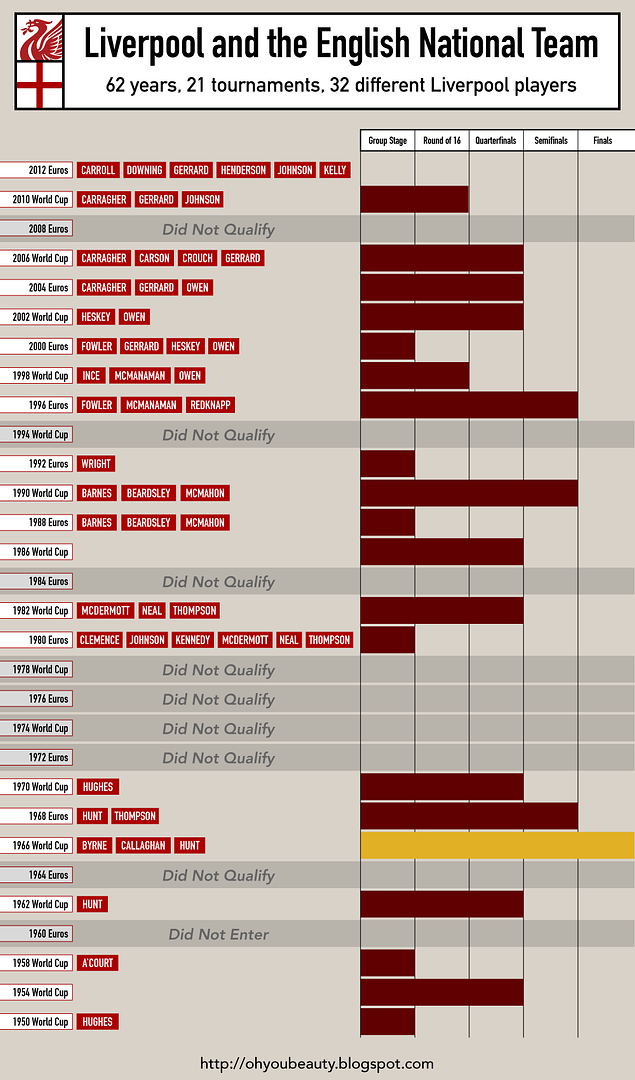
• England have qualified for 21 of the 30 World Cups (13 of 16) and European Championships (8 of 14) held since 1950. Liverpool had at least once player in 19 of the 21 England squads. On average, Liverpool have had 1.92 players involved in an England World Cup squad and 3.5 in a Euros squad.

• One of those two tournaments where Liverpool had no players in the England squad was the 1954 World Cup, which took place just after the last time Liverpool were relegated. The other was the 1986 World Cup. In contrast to 1954, Liverpool won the league prior to that tournament. To be fair, Steve McMahon (first cap in 1988), Sammy Lee (last cap in 1984), and Paul Walsh (last cap in 1984) were the only English internationals at the club then (both Alan Kennedy and Phil Neal left Liverpool during the '85-86 season).

• I can't help but think Hodgson's taking so many Liverpool players as a form of punishment. With Kelly added to the England squad on Sunday due to Cahill's fractured jaw, the 2012 Euros squad equals the record for most Liverpool players in an England squad, set in the 1980 European Championships. Just as in 1980, no club has more in the English squad. Granted, Liverpool won the 1979-80 league championship while finishing 8th this season, so that probably doesn't bode well for the Three Lions. If you're wondering, England finished third in its group in the eight-team 1980 Euros, behind Belgium and Italy (but ahead of Spain!). All six Liverpool players featured in the first match, a 1-1 draw against Belgium, but only Phil Thompson played in all three matches.

• Liverpool have been the best-represented club six times: joint-top four times (2006 with Chelsea, 2000 with Manchester United, 1982 with Ipswich and Manchester United, and 1966 with West Ham and Manchester United), and with the outright most England players in the 1980 and 2012 Euros.

• Technically, England's 1982 World Cup campaign ended at the Second Group Stage, with 12 sides remaining, rather than the quarterfinals, finishing second in their three-team group behind West Germany. But I really didn't want to create a "Second Group Stage" category for just that tournament.


(ht Inter Leaning for the photo, from the 1966 World Cup Final)

03 June 2012

On Dirk Kuyt

Expected, but out of the blue. Kuyt to Fenerbahce is official, not long after initial reports surfaced early this morning.

So, what will you remember most? His hat-trick against United probably leads the list, and rightfully so, but we're not wanting for choices. There's his five strikes against Everton, including two game-winners. There are the crucial late winners against United, Sparta, Liege, Trabzonspor, City, and Wigan, among others. The latest goal in Premier League history, a 102nd-minute penalty to draw level with Arsenal in April 2011 or his essential equalizer against the same opponents in the first leg of the 2007-08 Champions League quarterfinals. And there's also what should have been yet another big game late winner in the Carling Cup final slightly more than three months ago.

By my count, 24 of Kuyt's 71 goals were game-winners, including 10 after the 80th minute. 24 of his goals were also scored after the 75th minute, that desperate period as the clock ticks closer to midnight. Those two stats sum up Dirk Kuyt perfectly. So does the fact that he scored 12 goals in 40 Champions League appearances – a rate of just over 1 in 3 compared to his 1 in 4 rate in the Premiership and domestic cups – including memorable strikes against Inter, AC Milan, Arsenal, Chelsea, Porto, and Marseille. He is, simply put, a big game player – one of the highest compliments in sports.

Despite his form over the last nine months, which hadn't been good (to put it kindly), we can't downplay the significance of his exit, especially if it's coupled with Maxi Rodriguez's, as has been heavily rumored. Even in the most forgiving appraisals, it takes an existing hole in Liverpool's squad and rips it wide open.

I understand the rationale for both his exit. I don't like it. But I understand it. He's 31, fell off dramatically this season, and is most likely one of the highest earners at the club.

But Liverpool already have a shallow squad, as we're all well aware. It looked a lot better on paper in August, for a number of reasons, but the final few matches of the season (if not the majority of the campaign) put paid to that notion. Liverpool now need to replace an important player, one who could play multiple attacking positions. One who played 2378 minutes this season, starting 25 matches and coming on as a substitute in 19, which is no small amount. And Ideally replaced him with a younger better cheaper model, in addition to further purchases in both attack and central midfield, other problems made glaringly obvious over the course of the painful season.

If you have siblings, your parents probably lied to you; everyone has their favorite children. And we all have our favorite players, as much as we'd like to pretend the club comes first, etc etc. Kuyt, along with Lucas and Agger, has been one of mine since he joined the club.

His decline over the past year has been difficult to watch. He's not sparked to life in goals or assists after the winter, as in previous campaigns, with just five goals (two in the league) and two assists. Whether that's down to age or less playing time than before is up for debate; I fear it's the former. Still, he has more to give and, still in the Netherlands squad if not starting XI, has a right to want more playing time.

That the club want to lessen the average age makes sense, both for the overall health of the squad and the payroll. And that so many important players are the wrong side of 30 is yet another of the previous owners' sins. It was even worse before Comolli cleaned house last summer, one of the few things Damien still deserves credit for: Cole, Poulsen, Jovanovic, Kyrgiakos.

Regardless, breaking up is hard to do. Put your hands up. Put your hands up for Dirk Kuyt. The hardest-working man in show business.

Thanks for everything, Dirk.