Showing posts with label reliant on chalkboards. Show all posts

19 February 2014

Coutinho v Arsenal [Animated Chalkboard]


Consider this an experiment. I wanted to A) see what chalkboards looked like when animated step-by-step and B) remind myself how to make animated GIFs in Photoshop. So, a couple of days back, I asked "Coutinho v Arsenal or Suarez at Tottenham?" on Twitter, without context. Off the top of my head, those seemed to be the most worthwhile to animate: two of Liverpool's best individual performances, against two very good sides, and more complete all-around performances: something more than just 80 different passes (no offense to Liverpool's central midfielders). Coutinho v Arsenal won by a handful of votes.

So here we are. I'm not fully convinced of its usefulness – at least, its usefulness compared to the time it took to create, although any in the future won't be as arduous given that I now know how to create these – but I hope you enjoy.

If you'd prefer, here's the file as a YouTube video. The aspect ratio is a bit nutty, but it's legible at both regular size and in full-screen. If you'd like to pause at certain moments, etc.

Also, for thoroughness' sake, here's a table of all the incidents included, linked rather than embedded because it's massively long.

As with the match infographics, this would have been next to impossible if not for Squawka and StatsZone's chalkboards.

16 January 2013

On Suarez and Sturridge Against United

45 minutes is a piss-poor sample size, but there were some clues as to how Liverpool's new signing will link up with Liverpool's star player.

Heat Maps via Squawka:


Pass Combinations:


Overall Second Half Passes:


Both Suarez and Sturridge dropped deep, drifted wide, and spent time in the penalty box. Suarez actually spent less time on the flanks than in the first half, when he was supremely isolated in United's half, trying to find some way to have an effect. No matter the formation, both showed a willingness to switch roles, as well as the adaptability to do it successfully, despite never having played together in a competitive match.

Two of Sturridge's nine passes to Suarez were chances created: a layoff in the right channel which led to a blocked shot just before the move for Liverpool's goal and a ball over the top from the left for Suarez's tame header in the second minute of added time. One of Suarez's five to Sturridge created a chance: a long diagonal from right to left that led to Sturridge's shot into the side-netting in the 70th minute.

A fair few of Sturridge's passes came from the left channel, more of Suarez's passes came from the space between the lines in the middle of the pitch, much as you'd expect from an "orthodox" attacking #10. And, yes, I'd be remiss if I didn't mention that Sturridge made almost twice as passes to Suarez as vice versa and completed more passes in total in the second half. He actually passed to Suarez in the penalty box twice. Daniel Sturridge! I know, right!

That Liverpool basically played 4-4-2 (or 4-4-1-1; it wasn't 4-3-3, it wasn't really 4-2-3-1 either with Downing and Borini playing deeper than Suarez) meant that neither Sturridge nor Suarez really had to drift to the channels to defend or track back. Both Borini and Downing mostly stayed wide (one to better effect than the other).

This probably won't be the formation going forward, unless Rodgers tries to adapt his 4-2-3-1 for Suarez to feature as the #10. The Uruguayan would play the role very differently than Henderson, Allen, Gerrard, or Şahin. Shelvey might be the closest example; see his heat maps against Fulham and Stoke (primarily Fulham) last month. But Shelvey still dropped deeper, more involved in the midfield whether Liverpool were in or out of possession, than Suarez ever will. Or should be. And it might create even more problems in midfield, where Liverpool are already struggling to find the right blend of Lucas, Gerrard, Allen, and Henderson.

Nonetheless, as others have said, the way the two forwards linked up, joined by Borini just after the hour mark, looked promising. There were signs that both can play centrally or either can shift to the flank. Those 45 minutes against the league leaders, where the league leaders were on the back foot on their own ground, demonstrate that – as hoped – Sturridge and Suarez could well be versatile enough (and clever enough) where their starting position truly doesn't matter.

17 September 2012

How Does Your Sterling Grow?

"I said when I first came here, I won't judge people on their status or what they've done, it's about what I see now in front of me, and [Sterling's] a young player who's improved every single day since I came in here."

"He was a player who played on his own, in the one v one. You look at him now, playing for the team, his tactical understanding playing against a really experienced player. He was blocking the line of pass, he was pressing at the right time, he was coming back to block the lines inside."

Brendan Rodgers after the Manchester City match


Passes
Sunderland: 33/35 (94%) [most accurate in the side]
Arsenal: 27/31 (87%)
City: 24/30 (80%)


Attacking Third
Sunderland: 16/16 (100%) [most accurate in the side]
Arsenal: 17/20 (85%)
City: 13/16 (81%)

Passes Received
Sunderland: 48
Arsenal: 40
City: 34


Shots
Sunderland: 2 (1 off-target, 1 blocked)
Arsenal: 1 (off-target)
City: 0

Chances Created
Sunderland: 4 [joint most created in the side]
Arsenal: 1
City: 2

Take-ons
Sunderland: 5/11 [joint most successful take-ons in the side]
Arsenal: 3/6
City: 0/1


Tackles
Sunderland: 5/5 [most successful tackles in the side]
Arsenal: 2/2
City: 1/2


Fouls Suffered
Sunderland: 7
Arsenal: 1
City: 1

Admittedly, Sunderland were weaker opposition than either City or Arsenal, even if the result doesn't necessarily show it. Regardless, that Sterling's output has improved in each successive start can't be overlooked.

Each link goes to the StatsZone chalkboard for that match, but I embedded the images for the categories I thought most relevant. His passes show he was more involved in the build-up, coming inside more often even though he was a right-footer playing on the right. Similar goes for the 'passes received' category, coming inside and deeper to make himself more available but also stretching play by getting the ball near the penalty box more often. He attempted and completed far more take-ons than in his two previous league starts, more of which took place directly outside the penalty box. And his tackles chalkboard against Sunderland is massively impressive for a winger, in his own half and the opposition's, let alone a 17-year-old winger.

Everything Noel wrote two weeks ago still applies. He is too young to start every single game without risking his future, too young to be relied upon in match after match. However, his improvement in each match has been demonstrable, important, and demonstrably important. He's gotten better in almost every statistical category from City to Arsenal to Sunderland.

He's come a long way from "There are very few players in the world who get into a Premier League team at 17, never mind a top club. [Sterling] has certainly shown qualities and we'll decide over the next few weeks whether he stays and he's involved now or if he goes for a loan period." Which was said by Rodgers in mid-July, just before Liverpool's first preseason match.

On Saturday, Sterling was Liverpool's most accurate passer, overall and in the final third, and made the most successful tackles (both Gerrard and Kelly attempted more, but each had four successful). He and Suarez each created four chances and completed five successful dribbles – the most in the Liverpool team. Sterling suffered seven fouls, four more than the second most-fouled player. And three of those seven fouls came in the last ten minutes, including Seb Larsson's yellow card – Sunderland's only yellow card of the match – evidence of the home side's increasing desperation.

It was also heartening to see him do all this on the right side of the pitch. Both he and Borini have been far better on the left in previous matches; both had struggled to replicate their better moments on the opposite flank. Until Saturday, Downing arguably had been Liverpool's most-effective right winger.

I cannot emphasize the "we can't get carried away" mantra hard enough. But I also cannot help but express my surprise and joy at Sterling's accelerated development.

20 August 2012

On Suarez and Gerrard at West Brom

"Even if Liverpool gets better production from the supporting cast – and honestly, there's seemingly nowhere to go but up in that category – as [Suarez and Gerrard] go, so goes Liverpool."

I hate being right.

And yesterday, in the first match of the league campaign, Suarez misfired and Gerrard had little influence on proceedings, and Liverpool failed to take advantage when in control then succumbed to a wonder goal followed by multiple defensive errors and a sending-off. We're all well aware it's the not first time that's happened, and it most likely won't be the last. Agger and Skrtel's mistakes, Downing and Borini's ineffectiveness, and Phil Dowd being Phil Dowd also played a large role in Liverpool's inadequacy, but it sure felt like the rot started at the top.

Suarez's shooting


That's abhorrent accuracy, and yet Suarez was the only Liverpool player to put a shot on target. All three of Gerrard's were off target, while Borini, Cole, Downing, Johnson and Kelly took one and missed one. Two of Suarez's shots, the two off-target from inside the six-yard box, were clear-cut chances, errant headers from Johnson and Borini's excellent crosses. The first, mistiming his jump for Johnson's cross after good work from the stand-in left back on the half-hour mark, sure felt like a turning point when West Brom opened the scoring 13 minutes later.

But this is nothing new. Suarez had one of the worst clear-cut chance conversion rates in the league last season.

Opta's definition of a clear-cut chance:
A situation where a player should reasonably be expected to score usually in a one-on-one scenario or from very close range.
Suarez converted seven of his 25 clear-cut chances last season – 28%. Rooney? 17 of 29 (59%). Agüero? 13 of 27 (48%). Van Persie? 18 of 40 (45%). But those were three of the league's best finishers. However, this EPL Index chart (from this article) lists 33 attackers; just six had a worse conversion rate: Bendtner, Bale, Carroll, Defoe, Gervinho, and Kuyt. The league average was 39%; had Suarez converted at that rate, he would have scored three more goals last season.

His shooting accuracy against West Brom was even worse than last season's abysmal return. 48 of his 128 total shots in 2011-12 were on target – 38% – compared to yesterday's 25%. He took eight or more shots in just one match, with 11 in the 1-1 draw against Norwich (the most any player took in a Premier League match last season), and at least tested Ruddy with six of those 11 even if he didn't score, including one near-miraculous save in the fifth minute of added time to preserve the draw.

Dan Kennett wrote extensively on this topic for The Tomkins Times back in March, and his findings remain relevant.

There will be matches where Suarez's is unerring, where Suarez scores in style early and often. Unfortunately, after 54 matches for Liverpool, those like his hat-trick against Norwich have become the exception rather than the rule. Admittedly, it's slightly easier to forgive missed chances when the player creates so many of the chances by himself. But his two best opportunities yesterday came from crosses put on a plate by Johnson and Borini, and he failed to hit the target on either.

I'm not necessarily saying that Suarez needs to be used differently, especially this early into Rodgers' reign. There's the temptation to demand he plays wide, not used as the main goal-scorer, which will only increase if this trend continues. And his talents might serve Liverpool just as well, if not better, on the flank. But his ability to run off the shoulder of the last man, to drag defenders out of position with his movement or with the ball at his feet, and his ability to involve others in the attack seem suited for his current role. He played on the flanks more often at Ajax, but it's no coincidence he's also become the central #9 for Uruguay since joining Liverpool.

However, if Suarez is going to play as a #9 in Rodgers' system, even if a roaming #9, a #9 as focused on creating as much as scoring, he needs to better that scoring return. And quickly.

Gerrard's passing


56 passes attempted, 46 completed. Just 17 passes into the attacking third, completing 12, with only one incomplete pass inside the penalty area.

Allen, Lucas, Suarez, Johnson, and Borini all completed more passes in that crucial area of the pitch. Gerrard's completion percentage in the final third was 71% – only Downing (7/10), Skrtel (1/5), and Reina (0/2) were less accurate, and both Skrtel and Reina were limited to long hoofed passes from their own half. Agger's red card started from one of those five unsuccessful attacking third passes, the mistake compounded by losing possession with so many Liverpool players in West Brom's half, as both Allen and Lucas went forward when Gerrard dropped deeper to receive possession.


Gerrard's overall pass completion percentage from open play was 82%, the worst of any outfield Liverpool player. And it's not as if the sending-off made him any less accurate, pushing too hard to try to haul Liverpool back; he was 27/33 when Agger went off, again, 82% completed, with nine of 11 successful in the attacking third but none of those 11 into the penalty box.


Gerrard also created two chances against West Brom – only Glen Johnson created more, with three – but both were fairly poor excuses for chances. The first, in the 50th minute, was when he spread play wide to Downing, with the winger running into traffic then taking an easily-blocked shot. The second came after Liverpool were down to 10 and down by two goals, in the 72nd minute, when he spread play wide to Cole, with the winger running into traffic then taking an easily-blocked shot.

There was little of the one-touch quick passing with Suarez, Borini, and Downing that caused so many problems against Gomel and Leverkusen. Gerrard passed to Suarez just five times; Allen and Kelly was Gerrard's most frequent targets, receiving eight and seven passes respectively from the captain. On the other hand, Suarez set Gerrard up 11 times – only Kelly to Skrtel, Johnson to Agger, and Agger to Johnson were more frequent combinations – but just one of those passes came inside the penalty area and just two were forward passes, one in the center circle and one where Gerrard burst forward from midfield ahead of the ball, as has been so crucial in the past.


And his crosses? Six attempted, zero successful. Borini also attempted six, but at least completed one – that one clear-cut chance for Suarez – while no other player attempted more than four. Incidentally, Liverpool delivered 22 crosses in total – they averaged 22.1 per match last season, the most in the league – but completed just three, a success rate of 14% where they averaged 19% in 2011-12. Needless to remind, but it was not a very successful tactic last season.

Moving Gerrard into a more attacking position was supposed to make him more influential, but he couldn't have been much less so on Saturday. Still, days like that will happen; time makes fools of us all and whatnot. But even when that happens, Gerrard's leadership and mentality remain vital qualities. They are more intangible qualities, but as captain, it's Gerrard's job to ensure heads don't drop and Liverpool keep playing after setbacks like Agger's red card or the second penalty. But Liverpool looked beaten as soon as West Brom's second went in; the last 25 minutes weren't even damage control, but playing out the clock, and it was little surprise that West Brom added a third. It wasn't the first time a team crumbled to dust after a sending off and it won't be the last, and, of course, a comeback was massively unlikely. But you never want to see the players look as if they believe that. All too often, Liverpool rolled over and died at the first sign of trouble last season. That trait cannot carry over into this one. Taking responsibility in an interview today, for the first penalty concession if little else, is a reassuring step, but words are far easier than deeds.

During this transitional phase with a new manager and a new system, Liverpool will rely on its established stars to carry them through difficult spells. It may not necessarily be fair to hold them to a higher standard, but it's warranted. Despite all else that occurred against West Brom – Dowd's decisions, Agger and Skrtel's penalties, inefficient flank play – when both Suarez and Gerrard disappoint, it's no surprise that Liverpool loses.

01 February 2012

Three Midfielders, Two Halves

It's been awhile since I trawled through the Guardian chalkboards for interesting items. I know, we all missed it.

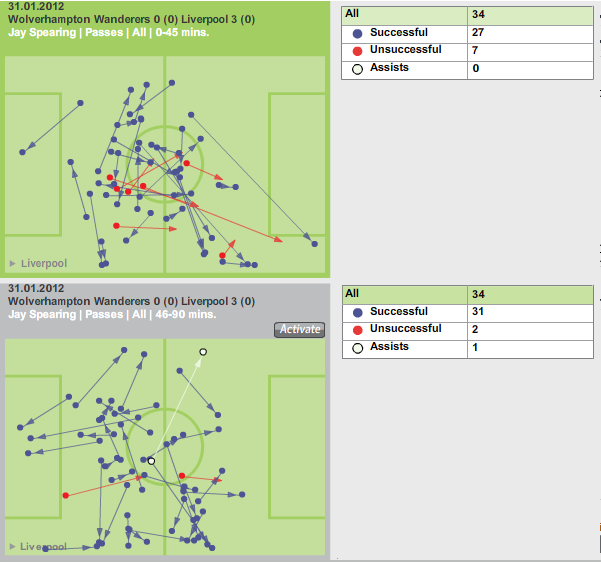
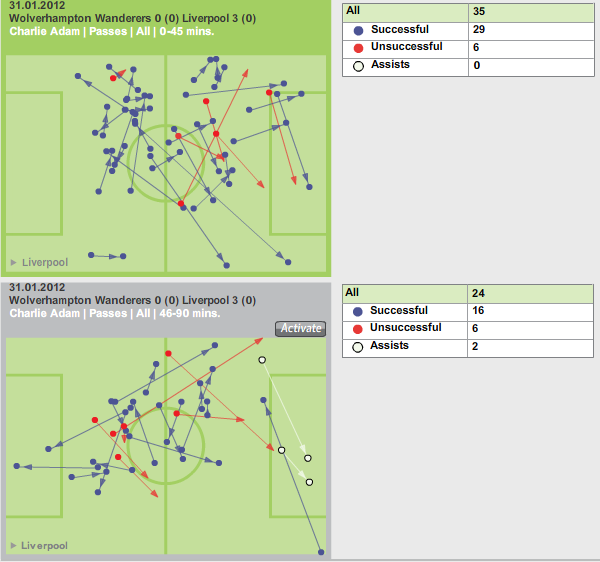
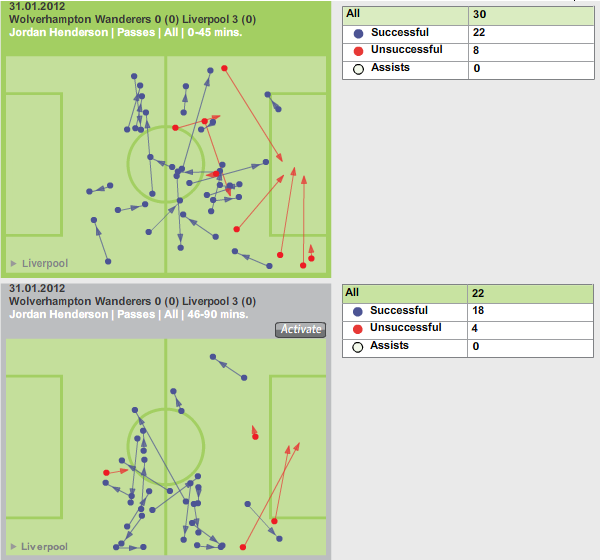
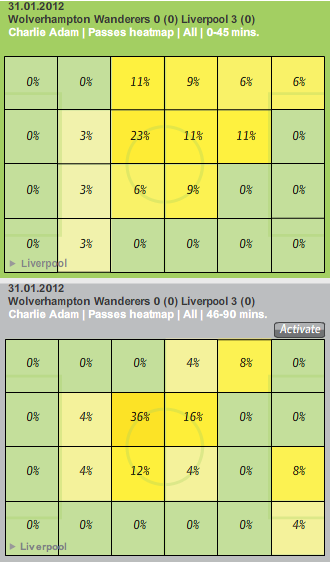
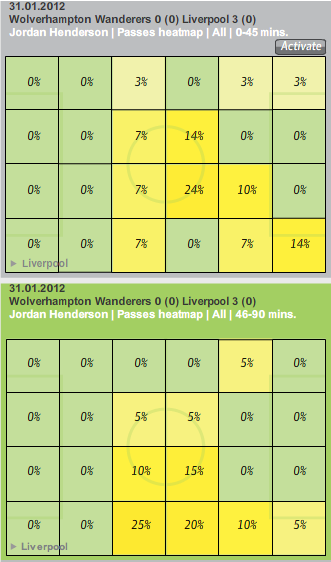
I remain convinced that Liverpool changed tact in midfield during the interval. The key seemed to be Spearing, more willing to stay in his own half and shield the defense rather than pressing higher up the pitch and leaving gaps. But the passing chalkboards suggest that all three central midfielders played differently in the first and second halves.


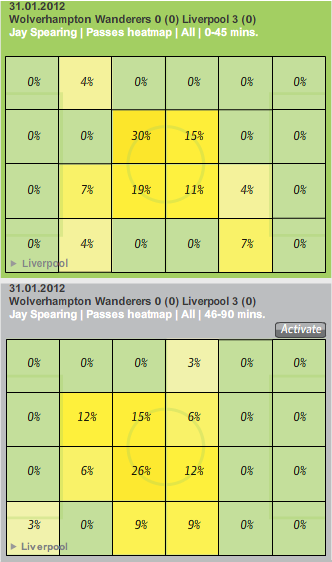
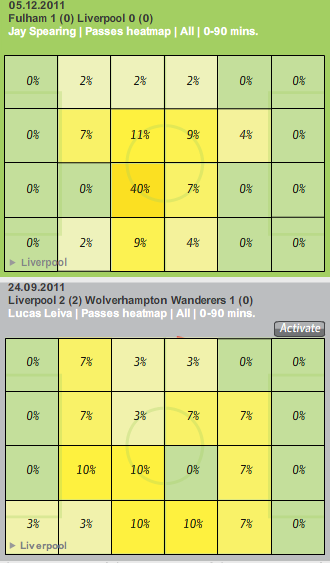
Both Spearing and Adam sat deeper, more content to hold their positions. Henderson was also less involved going forward, attempting fewer crosses (none of which he completed through 90 minutes), more concentrated on the right flank with Kuyt much more a striker. Spearing attempted the same number of passes, Adam and Henderson both attempted fewer. Spearing and Henderson had an improved completion rate, while Adam sacrificed a slight drop in accuracy but provided two much-needed assists.
The passing heatmaps make these trends more noticeable.


Out-and-out attack is all well and good, and often needed for this Liverpool side to score again less-fancied opposition, but the base in midfield is crucial for starting these attacks while still securing the defense. When Spearing and Adam go forward, gaps appear if either, or anyone else, loses possession, especially with both Johnson and Enrique bombing forward, which they did yesterday and often do against less-fancied opposition. And this led to a couple of Wolves' first-half chances, which, thankfully, Wolves couldn't take. Comparatively, the home side had just one second-half chance, Ebanks-Blake's rocket from nowhere, despite needing goals and shifting to 4-4-2 after Liverpool's second.

Liverpool may have had more possession in the first half (55-45% at half-time, 53-47% at full-time), but that's as much down to Liverpool being able to sit and counter after finally getting on the score sheet. Counter-attacking which led to the second and third goals. And a focus on counter-attacking also allowed Spearing and Adam to focus more on defending. But, of course, Liverpool needed to score first for that change in tactic to be successful. Round and round in circles we go.

Admittedly, Spearing's second-half improvement can also be credited to simply playing. He's missed far too much time over the winter months, first due to an unfair suspension, then following an injury in the first leg of the Carling Cup semi. It wouldn't be surprising if he needed time to find his sea legs. Hopefully, now back to fitness, he'll continue this improvement, especially with Gerrard back in the side.

---
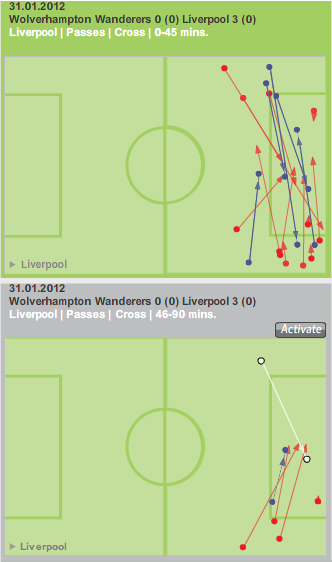
Finally, a bonus chalkboard. It has little to do with the point made above, but is just as crucial to Liverpool's style of play and results.


In the first half, Liverpool attempted 17 crosses, completing five. In the second half, Liverpool attempted six crosses, completing two, one the assist for the opener.

Kuyt was 3 for 8 on crosses, Henderson was 0 for 7, Adam was 2 for 3, Bellamy was 1 for 3, and Enrique was 1 for 2. 13 of the 23 total crosses came in the first 20 minutes – an average of one every 90 seconds or so – when Liverpool were clearly on top but, again, couldn't take advantage of dominance.

I've grumbled about Liverpool's crossing before, and had Liverpool kept up its first-half crossing pace, yesterday's match would have rivaled 3-1 at Newcastle and 0-3 at City for most crosses in a league match. Punting the ball toward Carroll is an obvious tactic, something the striker thrives on. But it's not the only thing he thrives on, and usually better for the team as a whole when used as an alternative – a Plan A only if there's a viable Plan B, not the lone source of attack. The second half, where Liverpool attempted fewer and one finally led to an assist, bears that out.

06 December 2011

On Suarez and Spearing's Positioning

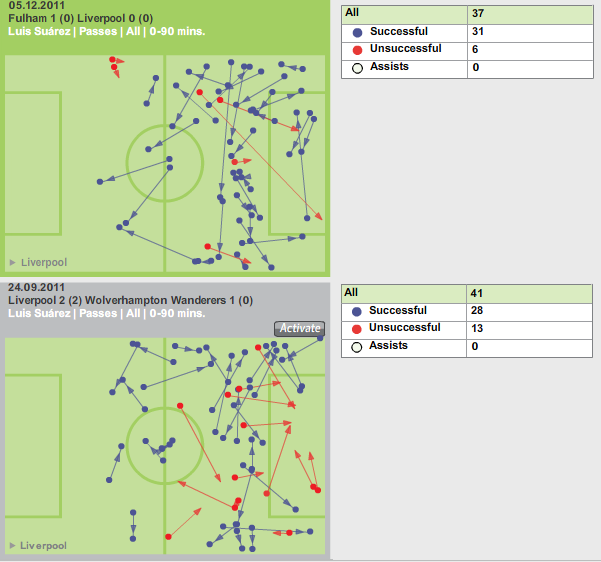
Lucas' absence and Liverpool's subsequent change in formation altered the position of two of Liverpool's key players against Fulham: whoever the holding midfielder is and Luis Suarez.

Jay Spearing often played further up the pitch than Lucas usually defends, while far more static in general. The 4-3-3 formation, with Carroll as center-point and Suarez and Bellamy lurking on either side, meant Liverpool's talismanic Uruguayan took up positions further from goal.

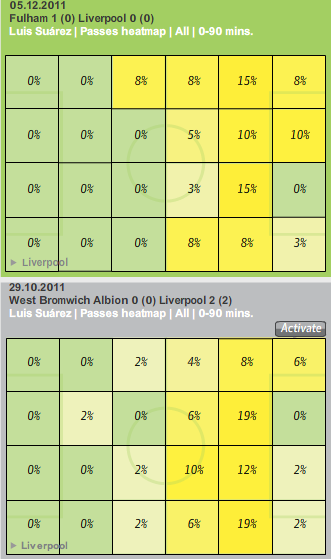
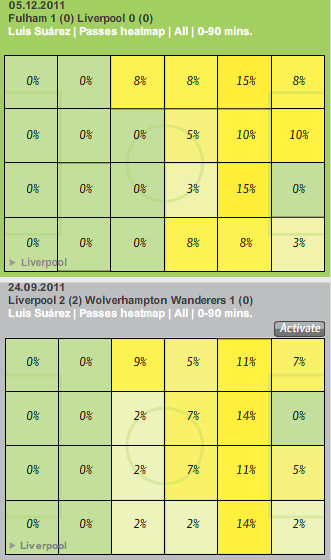
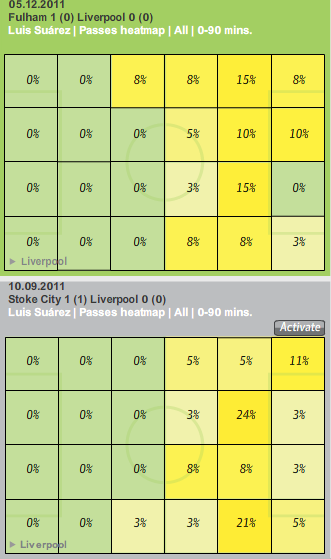
I'm using West Brom away, Stoke away, and Wolves at Anfield as points of comparison in chalkboards below. As said in yesterday's review, I think West Brom is the strongest parallel except in finishing – similar opposition playing style, away from Anfield, and with Carroll and Henderson starting. Stoke away is comparable in result, losing despite domination, while Wolves at home was another where Liverpool's performance disappointed but the side ground out a result due to taking its chances early on. The possession, passing, and shot statistics against Fulham are relatively similar to those against West Brom and Wolves; the result is the same as that against Stoke. If anything, stats from Stoke and Fulham – the two losses – look "better" than those against Wolves or West Brom.

As usual, click on the chalkboards to make them pop-up full size.

Suarez


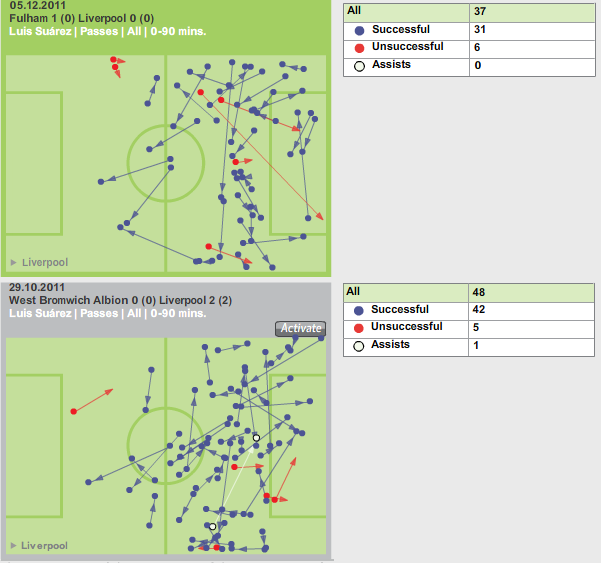
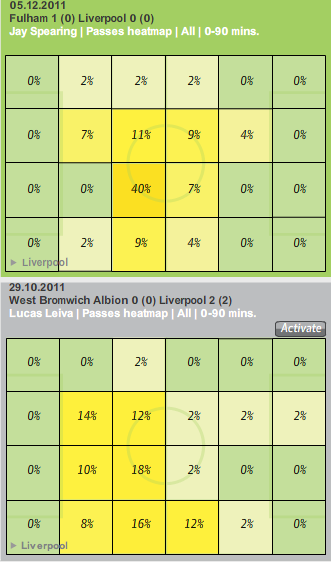
The chalkboards and heatmaps against Fulham show Suarez making more of his contributions further from the penalty area, whether deeper centrally or spending more time on the flanks. He attempted the fewest passes from these four matches against Fulham, and his performance is especially disappointing in comparison to that at West Brom – where he won the penalty and set up the second goal.

Suarez was widely known as a wide forward with Ajax before coming to Liverpool, but he's played as an out-and-out striker in almost every match under Dalglish, and is now playing a similar role with Uruguay (see Zonal Marking's Copa America reports, among others). His performance in a three-man front, an admittedly unfamiliar role at Liverpool, left much to be desired.

Update: Should have included take-ons as well. StatsZone chalkboards from Fulham (1 successful, 5 total), West Brom (3 of 6), Wolves (4 of 9), and Stoke (4 of 12).

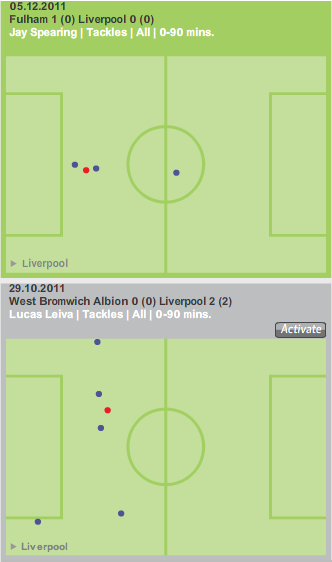
Spearing


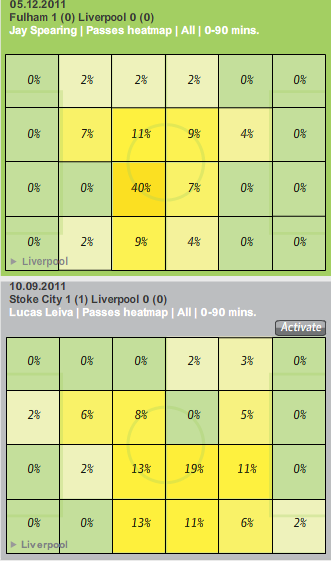
Unlike in Suarez's case, the amount of passes played seemed less important than the location, so I'm just including the heatmaps. That 40% zone stands out like a Las Vegas neon sign, surprisingly static, and further forward than Lucas usually plays. There was less movement in Liverpool's midfield without the Brazilian, as well as more space between the holding midfielder and back four, allowing more shots from distance than Liverpool regularly permits.

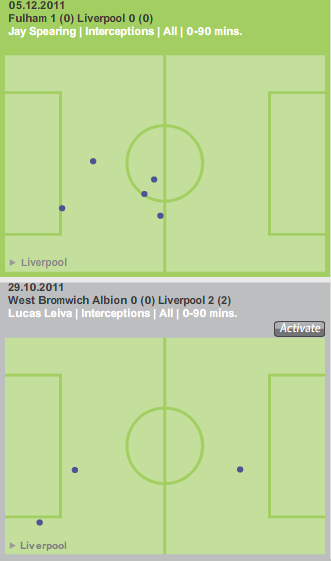
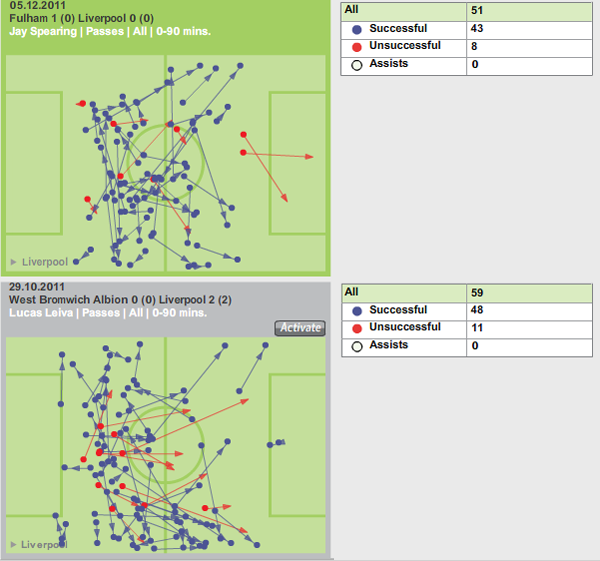
More chalkboards from Spearing at Fulham compared to Lucas against West Brom:


Spearing's tackles all occurred in the center of the pitch and most of his interceptions are in the same zone where 40% of his passes came from. Filling in for Lucas is a weighty burden, and it's a new role without a Brazilian safety net. Lucas partnered Spearing in all ten of the Liverpudlian's starts under Dalglish last season and in three of four prior to Fulham this season; Spearing with Adam in a 4-2-3-1 against Exeter had been the lone exception.

To be fair, Dalglish may have shifted to a 4-3-3 because of the opposition or to try to use Carroll, Bellamy, and Suarez at the same time, rather than because of Lucas' absence. Given how rarely we'd seen the formation – at Spurs was the only other time this season by my count, and that didn't last long; incidentally the only other time Liverpool's incurred a red card this season – some struggles are to be expected. But at the first time the question's asked, it's frightening evidence that Liverpool will miss Lucas Leiva very, very much.

22 November 2011

Chelsea Chalkboards - Half by Half

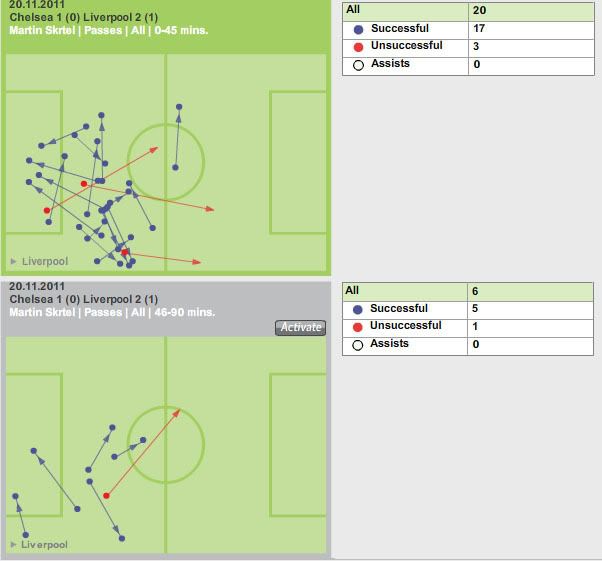
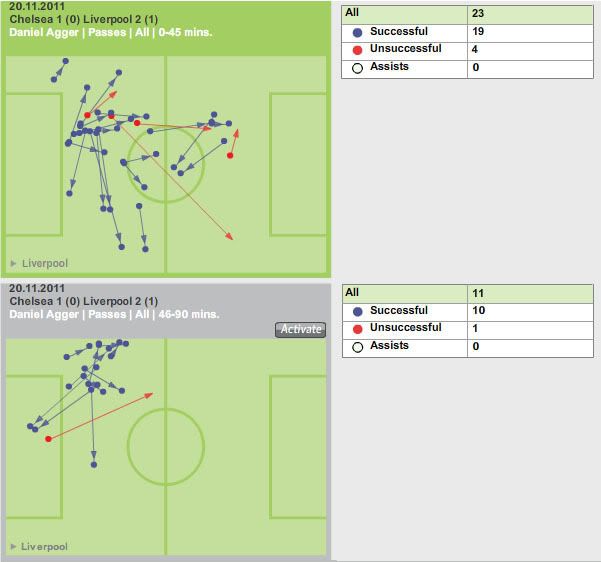
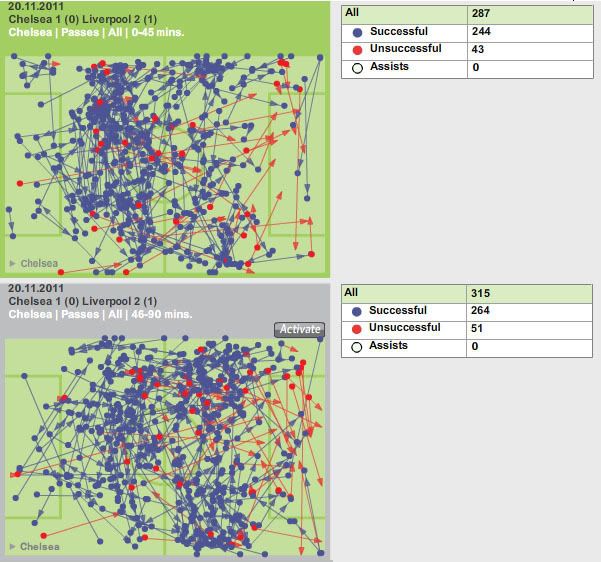
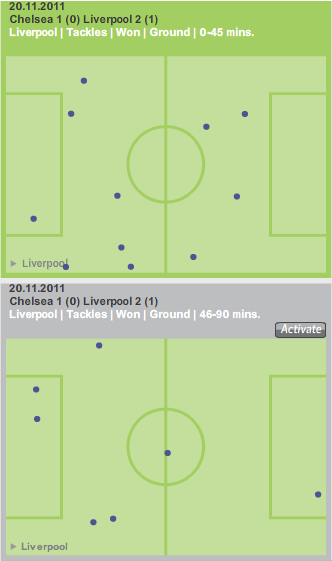
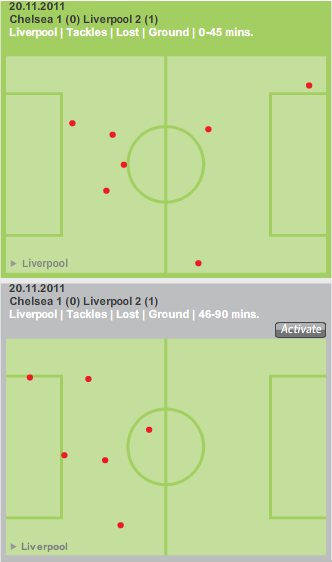
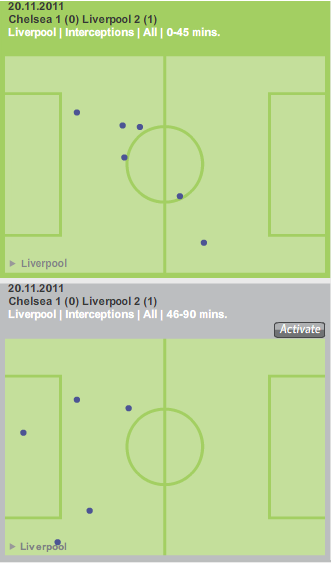
You don't need chalkboards to tell you that Liverpool changed tact in the second half against Chelsea, unable or unwilling to keep pressing in the same furious manner as the first. This isn't revelatory information, and I tried to explain why in the match review: pressing for 90 minutes was an impossibility due to fitness and personnel, so Liverpool went all out for the early goal, then tried to soak up pressure and hit Chelsea on the counter in the later stages. Despite conceding early in the second half, it worked a treat due to Johnson's bursting run and Chelsea's less than diligent defending, which I wrote about yesterday.

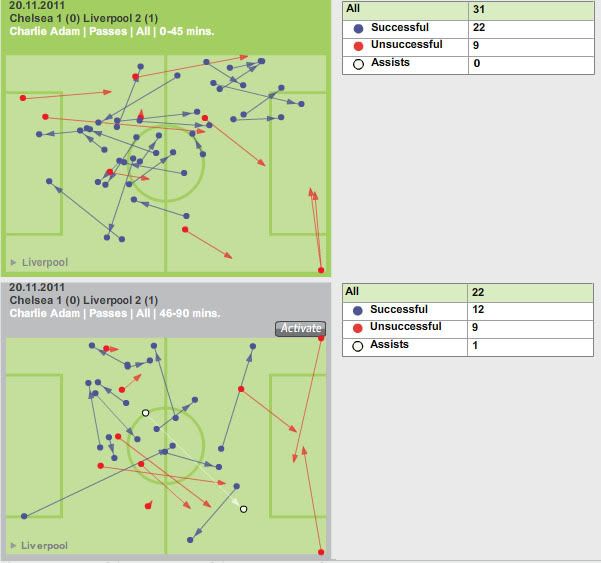
Nonetheless, it's interesting to compare the differences in a few passing charts and defensive chalkboards.


In the second half, there were fewer passes attempted by almost every Liverpool player, more Chelsea passes in Liverpool's half, tackles and interceptions came closer to Liverpool's goal, etc., etc. How few passes the center-backs attempted in the second half was the only major surprise, as it's quite noticeable despite Liverpool being under Chelsea pressure for long stretches. I'll also note than neither center-back "emptied it" regularly; while both Skrtel and Agger attempted far fewer passes, they're still short passes, attempting to build from the back. And Reina's passes and Liverpool's total attempted clearances (neither shown) stayed fairly similar from first to second half.