Showing posts with label Passing Wheel. Show all posts

10 August 2012

On Joe Allen

Well, that took long enough. All that haggling, only to eventually, finally, reportedly meet Joe Allen's £15m release clause. Well done, Ian Ayre, you shrewd so and so.

Now then. I truly hate the "if he wasn't British…" or "if he were Brazilian/Spanish/nationality du jour…" aphorisms that frequently fly around whenever Liverpool – or some other club – buy a British player. It's facile, and it's often simply incorrect. Most British players (read: English) have very British (read: English) talents, tendencies, and faults. But not in this case.

Admittedly, it's hard to look past nationality after the utter flaming failures that were Liverpool's purchases last summer. However, forget last summer, as hard as that is. Joe Allen is not your typical British signing.

• EPL Index: Joe Allen – Statistically Compared to Rivals
• The Liverpool Word: Joe Allen – What would he bring to Liverpool FC?

For one, Allen was one of the best passers in the league last season: in volume, accuracy, and effectiveness.

The above articles comb through his stats effectively, but a look at his passing wheels (previous examples – for Lucas, Adam, Henderson, and Gerrard – here) helps clarify. Here are two of his best matches: against Arsenal, when he was ostensibly an attacking midfielder and tallied one of his two assists, and against Blackburn, when he was ostensibly a defensive midfielder and tallied the other.


Here are the StatsZone chalkboards for Arsenal and Blackburn.

An incredible volume and accuracy, especially when used as a deeper-lying midfielder, but predominantly short sideways and backwards knitting passes, with comparatively few forward passes. He is a link player, a player who keeps possession and keeps play moving. Which is the type of player and type of passer that Liverpool needs.

In these two matches, Allen was a defensive midfielder who joined in the attack against weaker opposition, and an attacking midfielder with a fairly extensive defensive brief against one of the best sides in the league. Allen made four tackles (six attempted) and two interceptions against Blackburn. He was five for five on tackles with one interception against Arsenal. Which was slightly ahead of his 3.1 tackles-per-game average (110 total), slightly behind his 2.1 interceptions-per-game (74 total).

While the tackles total is impressive, especially for a player not known as an out-and-out defensive shield, I'm more interested in the interceptions. This is a composite of all 36 of his matches, via Stats Zone.


That's a fairly effective defensive shield. Not to mention that 23 of Allen's 74 interceptions came in the opposition's half.

Allen may not be billed as an out-and-out defensive midfielder, but he was Swansea's more often than not. As much as Swansea used one in Rodgers' system. Only two players made more tackles over the course of the season: Cabaye and Dembele. Only nine midfielders made more interceptions: Mulumbu, Petrov, Gamst Pedersen, Parker, Cabaye, Modric, Reo-Coker, Cattermole and Jason Lowe. There's only two players on that list I'd rather have than Allen, and both are four years older and would cost even more. Had Lucas – a far more specialized defensive midfielder – completed the season, he'd have dwarfed those tallies, with 5.7 tackles-per-game and 2.8 interceptions when injured after 12 matches, but few others did. Spearing averaged 2.8 tackles and 1.1 interceptions, if you're curious. Enrique led Liverpool with 69 tackles, Agger with 59 interceptions.

Allen also completed 90 minutes in 29 of the 31 league matches he started, taken off after 75 minutes in his first start of the season against Arsenal and red carded in the 80th minute at Blackburn. Which is no small feat for a central midfielder, especially a 21 or 22-year-old. Comparatively, Adam completed 19 of his 27 league starts, Henderson 21 of his 31, and Lucas 10 of his 12.

Gerrard-Allen-Lucas would be an outstanding midfield, – my first choice, and arguably better than any except Manchester City and Chelsea's – but Gerrard-Henderson-Allen also appears outstanding, and would lose little steel were Lucas as unavailable this season as he was in the last (*knocks furiously on wood*). And then there's the future – Henderson-Lucas-Allen. Lucas is 25, Henderson and Allen 22. Not to mention that Jonjo Shelvey is just 20. Those five are Liverpool's top five central midfielders, the ones who'll see the most playing time. And their average age is 24.2, which includes a 32-year-old Steven Gerrard. The average age of Henderson-Allen-Lucas-Shelvey is just 22.25. Since the summer of 2010, Liverpool have spent around £58m on central midfielders (and recouped around £37m in sales). This purchase should mean that position is set for a good long while.

There's also something to be said for players who have worked with the manager before, who know his system, beliefs, personality, and desires. Sure, it's one thing if that manager is Roy Hodgson (wave to Christian Poulsen and Paul Konchesky, everyone), but it's another if that manager is Rafa Benitez (Luis Garcia, Momo Sissoko), and hopefully another if it's Brendan Rodgers. There has to be a reason Rodgers is willing to splurge for Allen, in fee if not in wages, where he wasn't for Sigurðsson.

Were he not British, not subject to parallels with Liverpool's previous purchases or England's (and Wales', and Scotland's…) repeated, hilarious failings, this would be far less controversial. There's also the similarity in fee, seemingly well over the odds, but that concerns me far less. It's a bargain if he succeeds, it's frightful if he fails. Same as it ever was. Rather than paying over the odds for nationality, Liverpool's paying over the odds because of Allen's age– especially for a central midfielder – and because Swansea really didn't want to sell.

So what worries me? After writing all of the above… the similarities with last summer's transfer business. Less Allen's nationality, more that Liverpool again are prioritizing central midfield while there are clear, glaring, gaping holes elsewhere in the squad.

Gerrard, Lucas, Henderson, Adam, Shelvey, and Spearing. That's six central midfielders already on Liverpool's books.

Suarez, Borini, Downing, Sterling, and Cole. Those are Liverpool's wide forwards, a problem position before losing Kuyt, Maxi, and Bellamy, as written about earlier today. And either Suarez or Borini will start as Liverpool's central striker in most matches.

Whatever their faults – and each player has at least one – of that central midfield group, I wouldn't have complained (much) had Liverpool gone into the season with that unit. Yes, Liverpool would have had no one who can truly replace Lucas, as the club learned, at great pains, last season, but Liverpool could cope, and probably would have coped even better in Rodgers' preferred 4-3-3 formation. However, I cannot say the same about the wide forwards. Especially considering Rodgers' preferred formation.

At the same time, it's seemingly another example of Liverpool getting on the train at one of the last stations rather than early in the trip. Yes, it's a completely different manager and a completely different system, but I can't help but wonder had Liverpool bought Allen instead of Henderson or Adam last season. They'd certainly have paid far less than £15m. Or, to compare to Newcastle, who have been very good at getting value for money, Yohan Cabaye – a very similar player, albeit four years older – cost around £9m. And would cost nearly twice as much today

Liverpool have picked up a nasty, costly habit of buying players at the peak of their price, and once again seem to be paying maximum value. As said above, I'm not incredibly worried about the fee, especially if Allen progresses as last season suggested he's capable of, but Liverpool certainly aren't maximizing value either, something which FSG supposedly wanted and promised to do.

Still, once again, Rodgers gets his man, one of his transfer priorities, despite the fee and despite Swansea's unwillingness to sell and supposed clause about Rodgers not poaching players. If we're buying the Rodgers system, it's nice to see all the chips pushed into the middle of the table. Despite Liverpool's logjam in the middle, Allen should improve the side. Imagine yesterday's side with Allen in place of Shelvey; no offense to the youngster, who played well, but Allen would have been an even better fit in that swirling, swarming Liverpool tidal wave.

Yes, there are still holes, and yes, it's a risk. But it seems a risk well worth taking. Welcome to Liverpool, Joe.

22 August 2011

Midfield Partnerships vs Pairings

A quick note. Instead of the usual Guardian Chalkboards, there are links to the FourFourTwo StatsZone diagrams. Similar utilities, but StatsZone has a couple of features I like better, primarily the way they classify tackles, show passes in the final third, and its ease of use. If you have an iPhone, iPad, etc., I highly recommend it.

Against Sunderland, Lucas and Adam were a pairing. Two players playing in central midfield. Against Arsenal, they were a partnership.

Lucas is the more defensive of the two, but against Arsenal, the Brazilian was able to join the attack more than usual. Adam, the more play-making, sat notably deeper and was far better in the tackle.

Compare where each made tackles against Sunderland and Arsenal: Lucas and Adam. The combination contributed more than half of Liverpool's total successful tackles (13 of 24) on Saturday.

The better understanding allowed Lucas more influence. Adam didn't attempt to dominate proceedings and his partner benefited. Both alternated going forward to better effect – for example, Adam in the run-up to the Henderson chance in the 23rd minute or Lucas's role in Suarez's clinching goal. When one went forward, the other knew to sit, and it wasn't just Adam going forward willy nilly.


After the match, I posted a link to each's passes in the attacking third on Twitter, somewhat surprised that Lucas completed more than his partner. Again, both Lucas and Adam's output was dramatically better than against Sunderland – Lucas, Adam – despite the fact the latter was at home against a bottom-half side and the former was at a ground where Liverpool had never won. Lucas attempted and completed far more, Adam's came further forward and were more dangerous. The Scot only had two unsuccessful passes into the opposition's penalty area a week ago. On Saturday, Adam had three successful and four unsuccessful entering Arsenal's box.

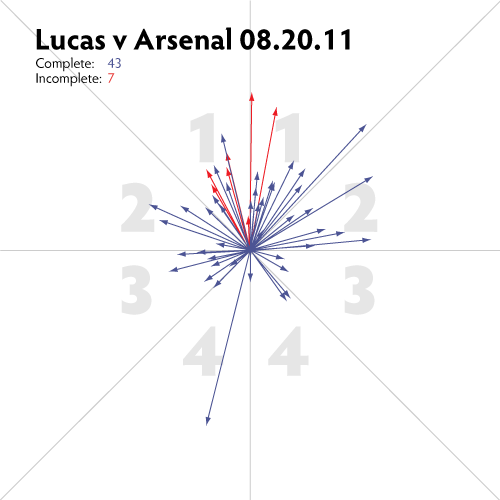
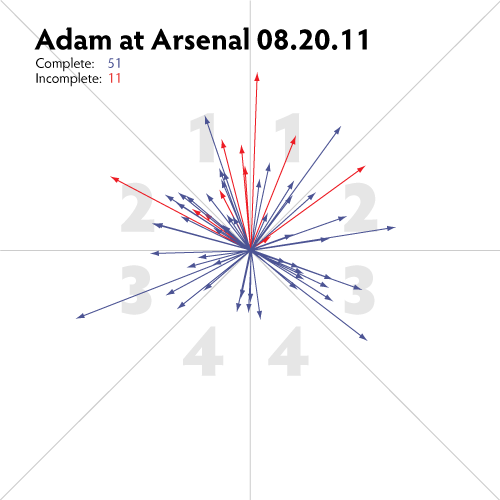
Both Adam's and Lucas' passing wheels (see previous passing wheels for Lucas, Gerrard, and Henderson.) were unsurprising on the whole, typical of each's style.

The Guardian Chalkboards (there's that crutch) for each can be found here. As usual, only open play passes are included in the wheel, so two free kicks from Lucas and three free kicks, two corners, and one throw-in from Adam aren't included.


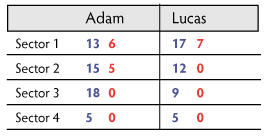
Each played his own game – Adam's passes were usually more ambitious, even sideways and backwards; Lucas had a higher completion percentage (86.0% to 82.3%) and looked for shorting, knitting passes. But countering some of the presumed beliefs, Lucas played fewer backward and had more going directly forward. In fact, the Brazilian's only unsuccessful passes came in the first quadrant.

You'd expect the two to better harmonize in their second game together. It takes time to make a central midfield partnership work; even Alonso and Mascherano took half a season to fully integrate. But Lucas and Adam's progression from a draw with Sunderland to a win at Arsenal was impressive, and bodes very well for the future, regardless of the opposition's current crises.

15 June 2011

Passing Wheel – Jordan Henderson

As actual news is sparse with the silly season in full flow (yes, I know it's barely mid-June), I thought I'd bring back the quasi-informative passing wheel (previously highlighted: Lucas and Gerrard) to take a look at three of Jordan Henderson's best games from the previous season.

The links will take you to the actual Guardian chalkboard for each game.

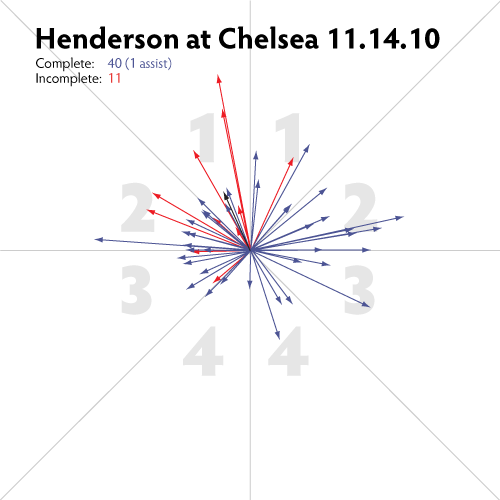
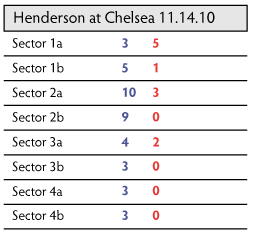
1) 3-0 at Chelsea (4-4-2 CM)


A fairly stereotypical, balanced central midfield performance. Not overly adventurous, with more passes in the 2nd quadrant, but diligent, with the majority of his passing moving play forward and a 78% completion percentage. His riskier passes – not necessarily a good idea at Stamford Bridge, even if your side is somehow running riot – were usually unsuccessful, but most attempts were the short "ticking over" passes so frequently derided. And those passes played a key part in handing Chelsea its worst home defeat since 2002, Sunderland's first win over the Blues in a decade.

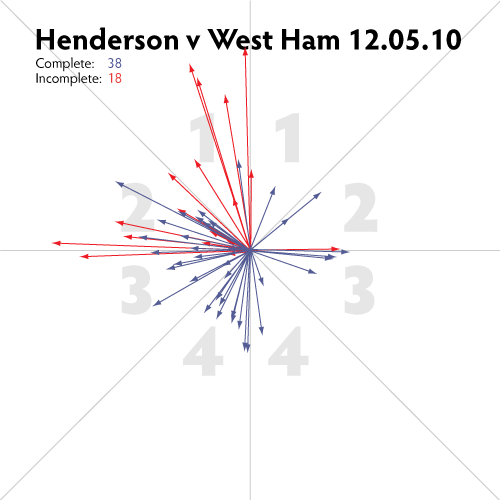
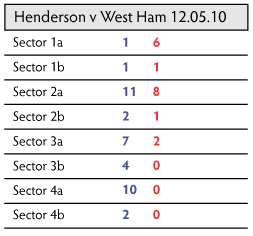
2) 1-0 v West Ham (4-4-2 RM)1


And a fairly stereotypical right-midfield performance. That 80% of his passes were to his left is little surprise: on the flank, Henderson passed infield to the central midfielders, looked for long-range diagonals, and crossed in the final third. There are far more backward passes, in the 3rd and 4th quadrants, mainly to bring the right-back into play or reset with the central defenders. His completion percentage is lower than usual at 68% (season average: 78%), but he also attempted more difficult passes than in the other two examples.

Incidentally, this game featured Henderson's first goal of the season, cutting inside to run into the box, smartly slamming home a centered ball from the flank. He didn't do that nearly enough – as he admits – scoring just twice more in 2010-11, both coming against Wigan in April.

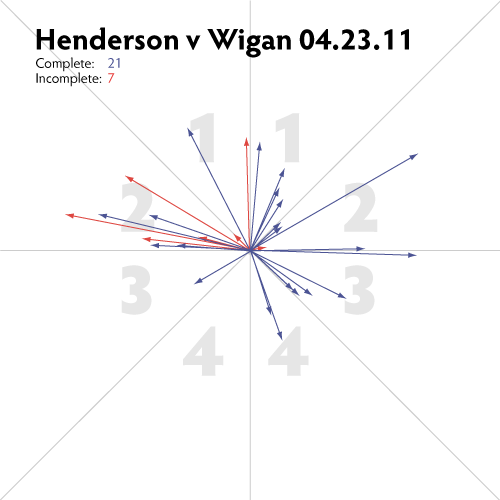
3) 4-2 v Wigan (4-4-2 RM)2


This is the one that interests me the most. Here's his two goals: the first after a sustained build-up, the second on the break, both from the middle of the penalty area after coming infield from the flank.

Ostensibly still a 4-4-2, in midfield with Cattermole, Colback and Sessegnon, nearly all of Henderson's passes came in the opposition half. The performance, while "less involved" than ideal (attempting just 28 passes in open play), seems almost prototypical for an attacking midfielder in Dalglish's 4-2-2-2 system. It bears more than a slight resemblance to what Liverpool's Portuguese midfielder did a week later on the right against Newcastle.


1 Not included are seven corners (three successful, four unsuccessful) and two throw-ins counted on the Guardian chalkboard.
2 Not included are seven corners (two successful, five unsuccessful) and one throw-in counted on the Guardian chalkboard.

02 March 2011

Passing Wheel – Gerrard at West Ham

Remember the passing wheel for Lucas posted two weeks ago? That was fun. Let's do that for Gerrard against West Ham last Sunday. We've got some time to kill before previewing the United match.


The word of the day is "more." More total passes, more ambitious passes, more incomplete passes, more sideways passes, and more backwards passes. Which makes sense given that Gerrard spends far more time on the ball than Lucas does. That's his role in the side. Gerrard attempted at least 10 passes longer than any Lucas tried against Wigan. Again, that's just how he plays.


There's a lot more red on Gerrard's chart, but it's easily explainable. More incomplete passes and more sideways/backwards passes are expected in a freer role and higher up the pitch. And West Ham were happy to pack their half of the pitch, especially after going ahead. Compare the actual chalkboard of Gerrard's performance to Lucas' against Wigan. Where the passes take place is fairly important, among other caveats that these snapshots don't come close to explaining everything. Simply put, Gerrard is asked to play a different role, no matter the formation.

But we can compare this performance to some of his past games. How about against the same opposition last season? Liverpool played 4-2-3-1, with Gerrard behind Torres, and won 3-2 in a back-and forth game. Or a match earlier this season, such as the 1-3 loss at Blackburn – Hodgson's final outing. Like Sunday's match, Liverpool were second-best and had to chase the game away from Anfield. As against West Ham this season, he was paired with Lucas in central midfield, albeit in an orthodox 4-4-2.


Here are the actual chalkboards: West Ham '09-10 and Blackburn. Corners aren't included in these wheels for obvious reasons. Gerrard didn't take any on Sunday, but took five (three successful, two unsuccessful) against Blackburn and two (both unsuccessful) against the Hammers last season.

The wheel from last year's match against West Ham demonstrates how Gerrard alters his game when playing as an attacking midfielder/second striker. Most notably, he attempted fewer passes and had far fewer incomplete. More passes in the 4th quadrant shows how he needed to hold up play and bring midfielders into the attack. There are still the usual long-range Hollywood attempts – one successful and three unsuccessful – but fewer than against West Ham this season or Blackburn.

There are a couple of similarities between his output last Sunday and the January match against Blackburn. The wheel appears flattened, a symptom of Blackburn's heavy pressing until going three up just before the hour mark, and Gerrard favored different halves of the pitch in each match (left against West Ham and right against Blackburn), but the total number of passes and percent completed are almost identical. Gerrard's completion percent against West Ham was 66.2%. It was 67.2% against Blackburn. Incidentally, it was 74.6% when playing behind Torres against West Ham last season.


There are examples of Gerrard playing well as a central midfielder, even from this season. Two that immediately spring to mind are the 2-3 loss against United and the 2-0 home victory over Chelsea. But those examples are increasingly few and far between. It's the age old debate. What's Gerrard's best position? And more importantly, what position is best for the team?

Noel from Liverpool Offside wrote a couple of posts on the subject following Sunday's loss, including a poll asking where people think he should play. Last I checked, attacking midfielder was running away with the vote, with 59% compared to 20.5% for central midfielder.

We still don't know what Liverpool's formation will be once everyone (read: Carroll) is fit. Whether three at the back becomes standard fare, Liverpool shifts to 4-3-3, or uses some variation of 4-4-2 or 4-2-3-1. We've seen them all since Dalglish took the reins. The plan will undoubtedly change over the summer when Liverpool gets a chance to upgrade the shallow squad.

But questions about whether Gerrard in central midfield is best for Liverpool have been asked for more than five years. I doubt they're going away anytime soon.

14 February 2011

Spin the Wheel

Every now and then, I stumble across an absolutely brilliant idea on someone else's website. When that happens, I usually steal it.

Last week, Dan from Aston Villa Central created what he called the "passing wheel," taking the Guardian Chalkboard passing data and re-plotting all the passes from a central point. It's utterly phenomenal.

As T.S. Eliot memorably wrote, "Immature poets imitate; mature poets steal." Don't bother looking up the second half of that quotation, by the way. Is it stealing if I give credit? Regardless, I wanted to use the idea to look at Lucas' body of work in Liverpool's last two matches.


What I like most about the diagram is how it highlights directionality. The myth about Lucas is that he's a player who plays the "safe" passes, playing sideways and backwards more often than not. These graphics help dispel that notion.


Out of the 103 passes attempted in both matches, 88 of them were played forward – 85%. 72% of Lucas' total attempted passes were both completed and went forward. Only 6 passes against Chelsea and 9 passes against Wigan were backwards and none were misplayed. 15 out of 103 attempts. So much for that myth.

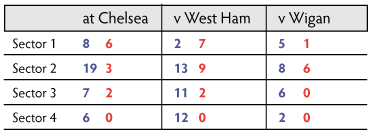
Interestingly, the right side of sector 1 is almost wholly vacant against Chelsea. Johnson and Maxi were Lucas' most frequent targets, both playing on the left side of the field. Aurelio, predominantly left-footed, was also a recurring outlet when he came on a substitute for Maxi. Kelly received only three passes from Lucas in that match. Lucas, as with the rest of the side that day, clearly had a specific task, planned down to the last detail by Dalglish and Clarke. It wasn't so regimented against Wigan, with an almost similar total between left and right sides, but still a slight preference to the left.

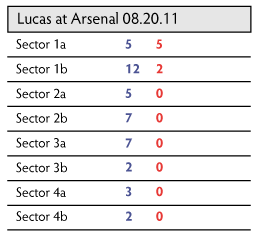
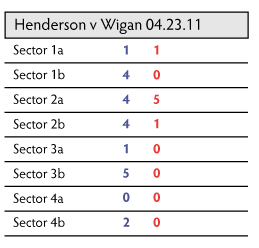
To break it down further, into sectors 1a and 1b etc with A as the left and B as the right...


Lucas was necessarily more "adventurous" against Wigan – more passes into sector 1 than 2, the opposite of his statistics against Chelsea – but also had a higher incompletion rate. More laterally balanced, searching for some opening in Wigan's compressed defense, and more inclined to push play ahead, as Liverpool needed to be on the attack, especially after conceding an equalizer. As happened to the team all too often, it didn't quite come off, but the intent was there. As a whole, Liverpool disappointed yesterday; it's not the fault of any individual. Except maybe the linesman who completely missed Gohouri being offside.

I will probably return to this style of graphic in the future. Plotting each pass is somewhat labor-intensive; I've only had the chance to study Lucas so far, and only the last two matches. That he's the primary defensive midfielder and due to the aforementioned prevailing myth, I thought his play would be a good starting point.

All season long, Lucas has been converting nonbelievers. Long may it continue.

Edit: Here are the actual chalkboards from Chelsea and Wigan.