Showing posts with label Spearing. Show all posts

01 February 2012

Three Midfielders, Two Halves

It's been awhile since I trawled through the Guardian chalkboards for interesting items. I know, we all missed it.

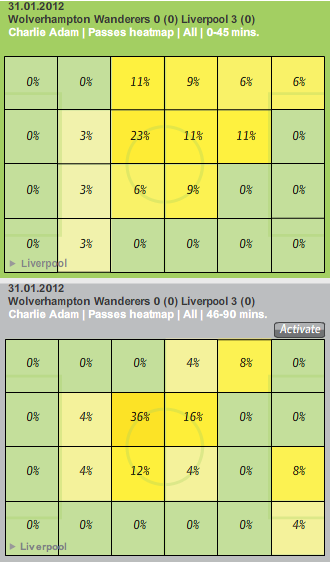
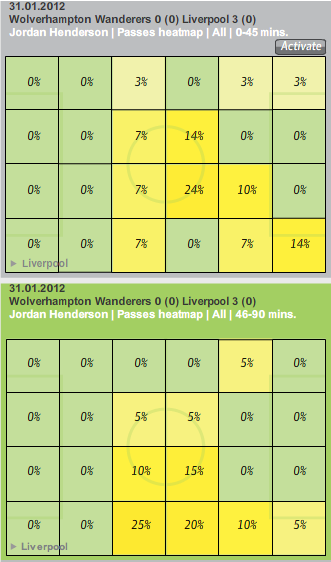
I remain convinced that Liverpool changed tact in midfield during the interval. The key seemed to be Spearing, more willing to stay in his own half and shield the defense rather than pressing higher up the pitch and leaving gaps. But the passing chalkboards suggest that all three central midfielders played differently in the first and second halves.
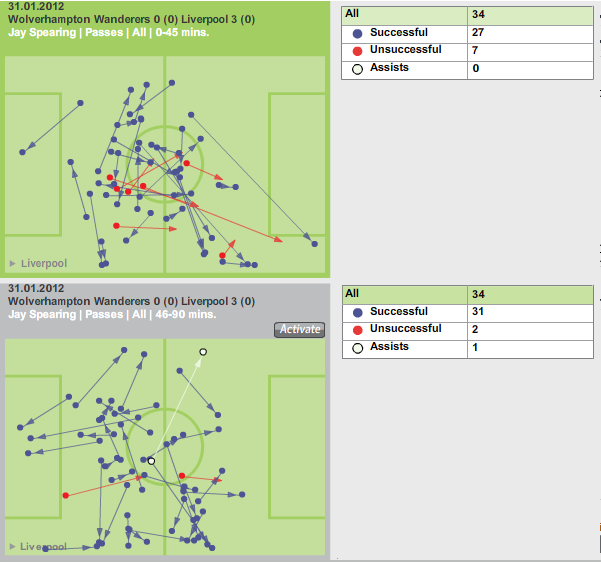
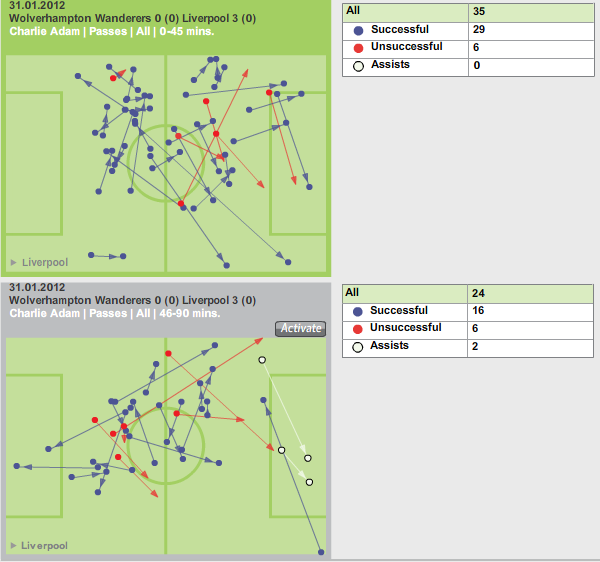
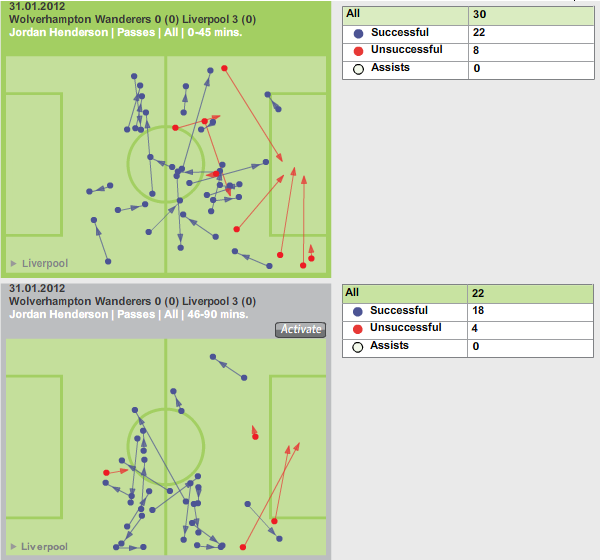


Both Spearing and Adam sat deeper, more content to hold their positions. Henderson was also less involved going forward, attempting fewer crosses (none of which he completed through 90 minutes), more concentrated on the right flank with Kuyt much more a striker. Spearing attempted the same number of passes, Adam and Henderson both attempted fewer. Spearing and Henderson had an improved completion rate, while Adam sacrificed a slight drop in accuracy but provided two much-needed assists.

The passing heatmaps make these trends more noticeable.
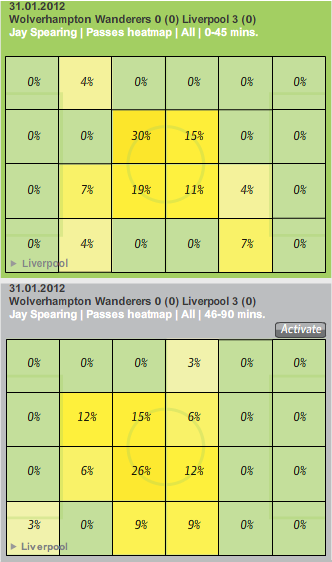


Out-and-out attack is all well and good, and often needed for this Liverpool side to score again less-fancied opposition, but the base in midfield is crucial for starting these attacks while still securing the defense. When Spearing and Adam go forward, gaps appear if either, or anyone else, loses possession, especially with both Johnson and Enrique bombing forward, which they did yesterday and often do against less-fancied opposition. And this led to a couple of Wolves' first-half chances, which, thankfully, Wolves couldn't take. Comparatively, the home side had just one second-half chance, Ebanks-Blake's rocket from nowhere, despite needing goals and shifting to 4-4-2 after Liverpool's second.

Liverpool may have had more possession in the first half (55-45% at half-time, 53-47% at full-time), but that's as much down to Liverpool being able to sit and counter after finally getting on the score sheet. Counter-attacking which led to the second and third goals. And a focus on counter-attacking also allowed Spearing and Adam to focus more on defending. But, of course, Liverpool needed to score first for that change in tactic to be successful. Round and round in circles we go.

Admittedly, Spearing's second-half improvement can also be credited to simply playing. He's missed far too much time over the winter months, first due to an unfair suspension, then following an injury in the first leg of the Carling Cup semi. It wouldn't be surprising if he needed time to find his sea legs. Hopefully, now back to fitness, he'll continue this improvement, especially with Gerrard back in the side.

---
Finally, a bonus chalkboard. It has little to do with the point made above, but is just as crucial to Liverpool's style of play and results.
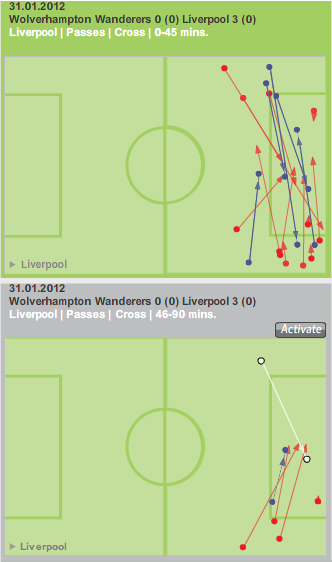


In the first half, Liverpool attempted 17 crosses, completing five. In the second half, Liverpool attempted six crosses, completing two, one the assist for the opener.

Kuyt was 3 for 8 on crosses, Henderson was 0 for 7, Adam was 2 for 3, Bellamy was 1 for 3, and Enrique was 1 for 2. 13 of the 23 total crosses came in the first 20 minutes – an average of one every 90 seconds or so – when Liverpool were clearly on top but, again, couldn't take advantage of dominance.

I've grumbled about Liverpool's crossing before, and had Liverpool kept up its first-half crossing pace, yesterday's match would have rivaled 3-1 at Newcastle and 0-3 at City for most crosses in a league match. Punting the ball toward Carroll is an obvious tactic, something the striker thrives on. But it's not the only thing he thrives on, and usually better for the team as a whole when used as an alternative – a Plan A only if there's a viable Plan B, not the lone source of attack. The second half, where Liverpool attempted fewer and one finally led to an assist, bears that out.

06 December 2011

On Suarez and Spearing's Positioning

Lucas' absence and Liverpool's subsequent change in formation altered the position of two of Liverpool's key players against Fulham: whoever the holding midfielder is and Luis Suarez.

Jay Spearing often played further up the pitch than Lucas usually defends, while far more static in general. The 4-3-3 formation, with Carroll as center-point and Suarez and Bellamy lurking on either side, meant Liverpool's talismanic Uruguayan took up positions further from goal.

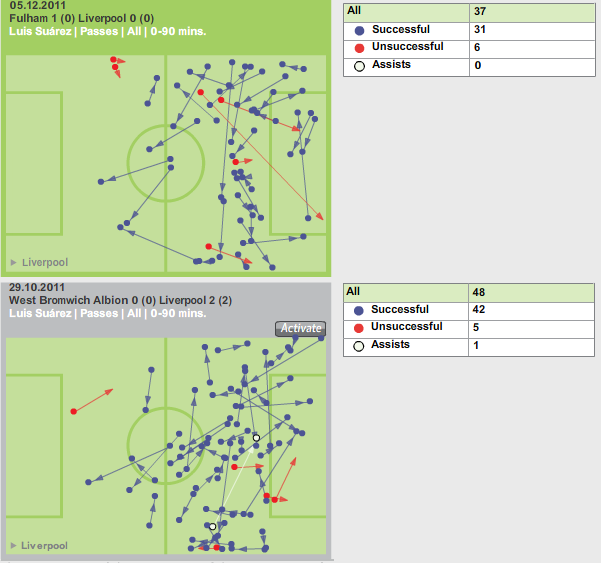
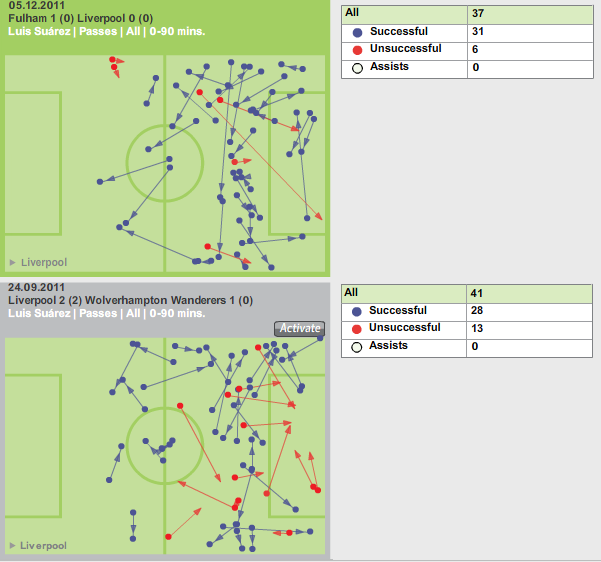
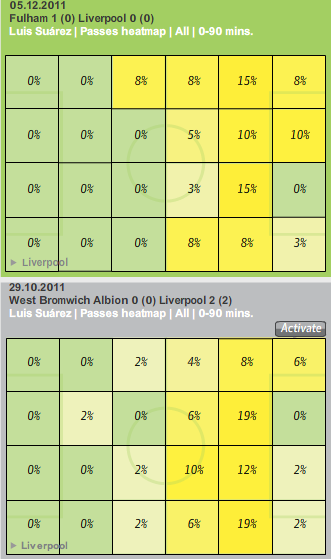
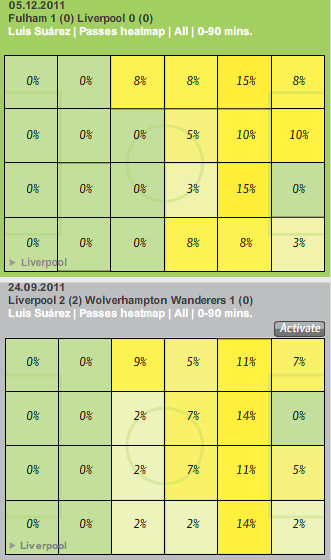
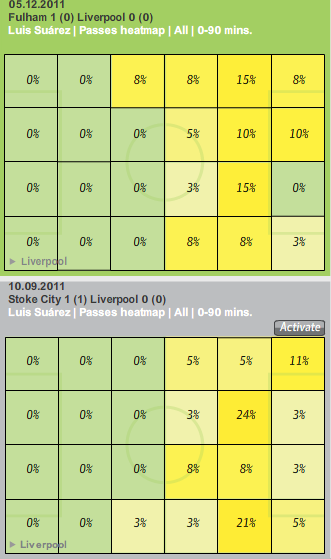
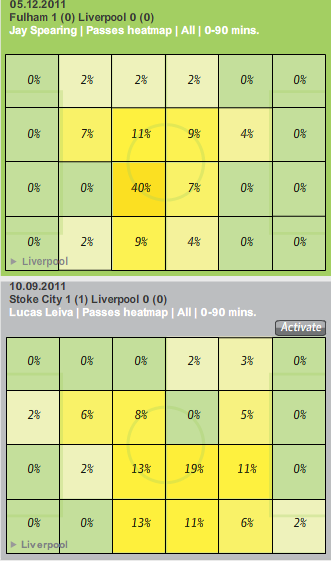
I'm using West Brom away, Stoke away, and Wolves at Anfield as points of comparison in chalkboards below. As said in yesterday's review, I think West Brom is the strongest parallel except in finishing – similar opposition playing style, away from Anfield, and with Carroll and Henderson starting. Stoke away is comparable in result, losing despite domination, while Wolves at home was another where Liverpool's performance disappointed but the side ground out a result due to taking its chances early on. The possession, passing, and shot statistics against Fulham are relatively similar to those against West Brom and Wolves; the result is the same as that against Stoke. If anything, stats from Stoke and Fulham – the two losses – look "better" than those against Wolves or West Brom.

As usual, click on the chalkboards to make them pop-up full size.

Suarez


The chalkboards and heatmaps against Fulham show Suarez making more of his contributions further from the penalty area, whether deeper centrally or spending more time on the flanks. He attempted the fewest passes from these four matches against Fulham, and his performance is especially disappointing in comparison to that at West Brom – where he won the penalty and set up the second goal.

Suarez was widely known as a wide forward with Ajax before coming to Liverpool, but he's played as an out-and-out striker in almost every match under Dalglish, and is now playing a similar role with Uruguay (see Zonal Marking's Copa America reports, among others). His performance in a three-man front, an admittedly unfamiliar role at Liverpool, left much to be desired.

Update: Should have included take-ons as well. StatsZone chalkboards from Fulham (1 successful, 5 total), West Brom (3 of 6), Wolves (4 of 9), and Stoke (4 of 12).

Spearing


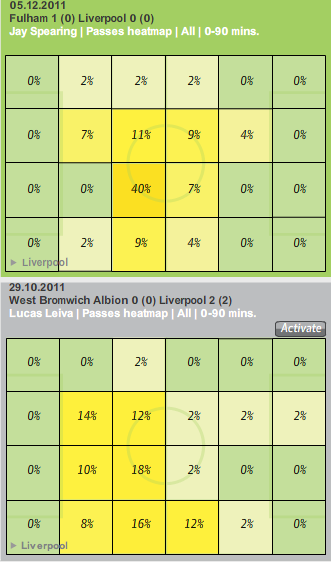
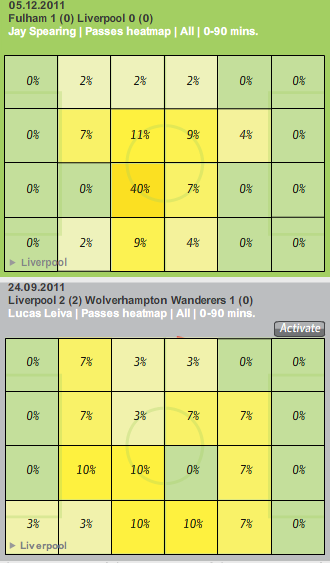
Unlike in Suarez's case, the amount of passes played seemed less important than the location, so I'm just including the heatmaps. That 40% zone stands out like a Las Vegas neon sign, surprisingly static, and further forward than Lucas usually plays. There was less movement in Liverpool's midfield without the Brazilian, as well as more space between the holding midfielder and back four, allowing more shots from distance than Liverpool regularly permits.

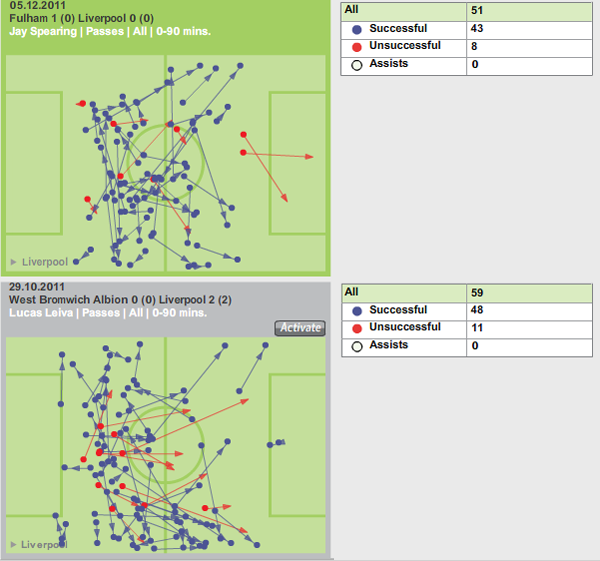
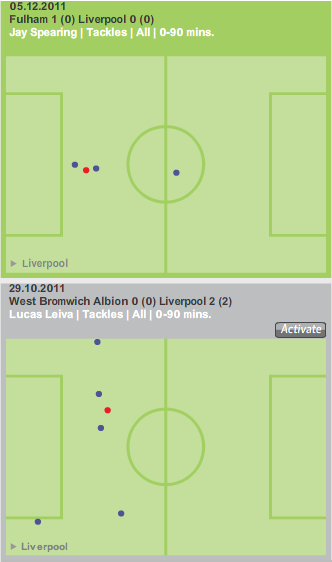
More chalkboards from Spearing at Fulham compared to Lucas against West Brom:


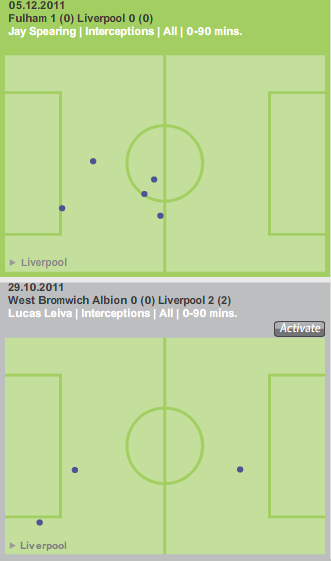
Spearing's tackles all occurred in the center of the pitch and most of his interceptions are in the same zone where 40% of his passes came from. Filling in for Lucas is a weighty burden, and it's a new role without a Brazilian safety net. Lucas partnered Spearing in all ten of the Liverpudlian's starts under Dalglish last season and in three of four prior to Fulham this season; Spearing with Adam in a 4-2-3-1 against Exeter had been the lone exception.

To be fair, Dalglish may have shifted to a 4-3-3 because of the opposition or to try to use Carroll, Bellamy, and Suarez at the same time, rather than because of Lucas' absence. Given how rarely we'd seen the formation – at Spurs was the only other time this season by my count, and that didn't last long; incidentally the only other time Liverpool's incurred a red card this season – some struggles are to be expected. But at the first time the question's asked, it's frightening evidence that Liverpool will miss Lucas Leiva very, very much.

20 April 2011

Jay Spearing is Not a Defensive Midfielder

Up until the last four games, Jay Spearing's rarely looked liked having a long-term future at Liverpool. Admittedly, he also hadn't gotten a consistent run in the side until Gerrard's season-ending injury, only once playing more than two consecutive games: earlier this season against Steaua and Northampton. He didn't stand out in cameos against Real Madrid and PSV in 2008-09, three starts in 2009-10 (the two league cup matches and at Sunderland), or seven appearances under Hodgson. Happily, with Liverpool's hand forced by injuries, he's shown remarkable improvement since the 2-0 win at Sunderland.

Since Xabi Alonso left, fans have alternated between cries of "Gerrard's not an orthodox central midfielder" and "Lucas and X are too defensive." And there's truth in both statements. Lucas/Mascherano was too defensive at times. Lucas/Poulsen was definitely too defensive, with the added bonus of Poulsen being so far over the hill he's on flat ground. Two managers have been mostly unwilling to play Meireles in a central midfield pairing with Lucas, aside from a two-week stretch against Spurs, Villa, and Newcastle. But the Lucas/Spearing partnership hasn't as defensive as initially feared.

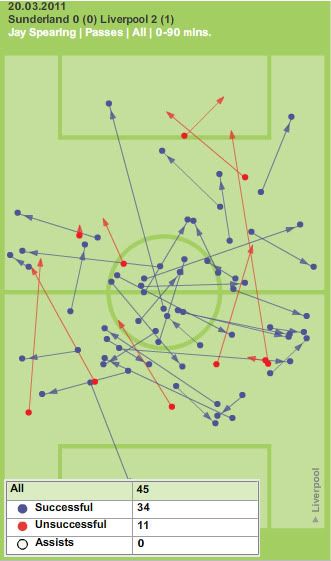
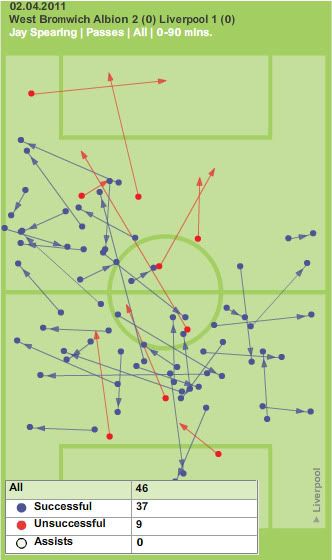
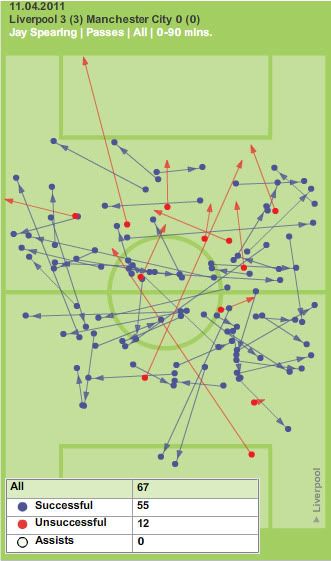
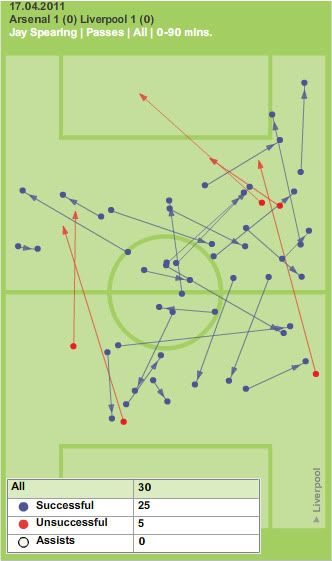
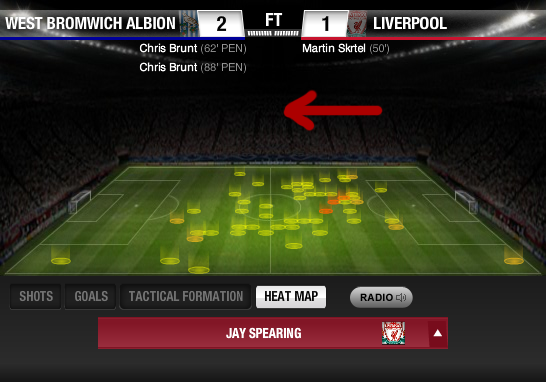
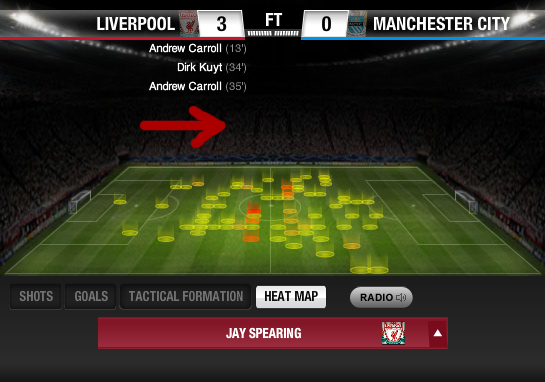
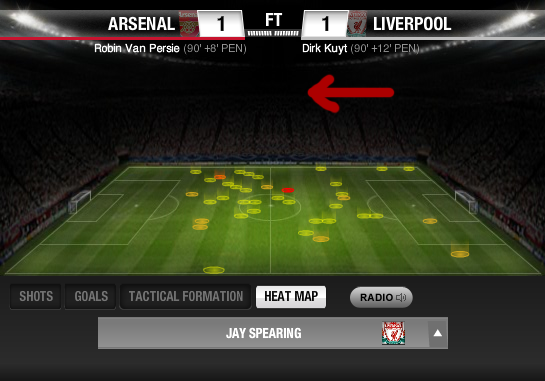
Spearing's passing chalkboards and heat maps from the last four games illustrate his development and abilities well.

Passing Chalkboards:


Heat Maps:

Click on the images. Trying a new plug-in; they should open full-size in a Javascript box. Let me know if there are any problems with this. My CSS knowledge is both dangerous and limited.

Unsurprisingly, the home match against City was his most-attacking performance of the four, if not the all-around best. It also happened to be Liverpool's largest win. He completed 18 more passes than against West Brom – his second-highest total of the four – and was more active according to the heat map. Liverpool bossed that game; it's no surprise to see Spearing's so influential.

But we can also see progression from Sunderland to West Brom to City to Arsenal. Despite his won penalty – another example of how he can get forward – the away match against Sunderland was his most "defensive" performance, evidenced by the heat map which shows his focus on the center circle area. Out-numbered in midfield against West Brom, in what was easily Liverpool's worst performance of the four, Spearing still attempted to prod Albion's defense down the left, shown in the passing chalkboard.

But the heat map and chalkboard from City and Arsenal show a player who's looking to link midfield and attack, highly-mobile and almost always on the run. Against both clubs, despite Liverpool's different strategies in the two matches, Spearing's heat maps show as much time spent in the opposition half as Liverpool's own – even against Arsenal, where Liverpool were frequently pegged back, but Spearing could have won another first-half spot kick.

I've been fighting the "Lucas is too defensive" stereotype since 2007. But Lucas is the defensive midfielder these days, and that's the area of his game which has most improved. He does rarely get forward, although still doesn't get enough credit for when he does – scoring against Benfica last year and Steaua this year, among others. No matter how he was billed when joining the club, the fact is that Lucas has become unarguably better when deployed deeper.

However, Spearing is more of a link player, and has become important to Liverpool's attack over the last month. Bustling, busy, and full of running, but still willing to get forward. These traits make him an ideal partner for Lucas.

The pairing still limits Liverpool in certain regards. Spearing doesn't have huge range of passing – Liverpool's weakness in this area explains Dalglish's January pursuit of Charlie Adam – while neither he nor Lucas score with any semblance of regularity. But intelligence and endeavor go a long way. And Spearing's dramatic improvement since earning his starting place bodes well.