Showing posts with label Suarez. Show all posts

11 July 2014

On Luis Suarez

We had the best of times, we had the worst of times.

While at Liverpool, Luis Suarez scored 69 league goals and tallied 23 league assists in three and a half seasons. In all competitions, his total jumps to 82 goals.

While at Liverpool, Luis Suarez was suspended eight games for racial abuse, one game for giving the finger to Fulham fans, two games for yellow card accumulation, 10 games for biting, and has a four-month ban for another bite looming.

While at Liverpool, Luis Suarez became one of the best players in the world, deservedly mentioned in the same breath as Lionel Messi and Cristiano Ronaldo.

With Luis Suarez, you get the angel and the devil, each precariously perched on a shoulder. You get Dr Jekyll, the supremely talented footballer, devoted family man, and a player conscientious enough to pen this farewell, and you get Mr Hyde. You remember what Hyde did.

This is no slight (well, a little slight) to Fernando Torres and Michael Owen, but Luis Suarez was the best striker I've seen in a Liverpool shirt. Not the best player – the current club captain still wears that crown – but undoubtedly the best attacker. Suarez's bag of tricks is a mile wide and two miles deep. With Owen and Torres, you knew what you were going to get. They each did it superlatively before injuries robbed them of their powers, but each relied on one trick: overwhelming pace. That was it, and when that pace was gone, they were gone. But Suarez could do everything, anything, scoring goals I'd never dreamed possible. There was no shot too audacious, no nutmeg he couldn't pull off, never too many defenders between him and the goal.

Last season, Suarez won the PFA Player of the Year, FWA Player of the Year, FSF Player of the Year, Premier League Player of the Year, Premier League Golden Boot, and tied for the European Golden Shoe. He either scored or assisted 43 of Liverpool's 101 goals – an unthinkable 42.6%.

He's gotten better in every season he's played for Liverpool, and is currently at the apex of his powers.


Since we're here, and since I've got no more use for them, I might as well post these GIFs of Suarez's Premier League goals for Liverpool. Made them about a month ago, then THE BITE PART THREE happened, then this transfer saga happened. Sigh.

Each minute that Luis Suarez played is equivalent to approximately 0.05 seconds in each GIF. The GIFs are each 55 seconds: 48 seconds of "action," seven seconds held on the last frame to catch your breath. There are two GIFs. First, an easy-to-follow chart, with one circle representing each goal and a running total of goals scored, minutes played, and goals per 90 minutes. The second is the familiar pitch view of goals scored that I've used a fair amount over the last few months.


And here is a link to the spreadsheet listing all of his PL goals.

Anyway. Memories are painful sometimes.

This was bound to happen. Sooner or later, bound to happen. I'm actually surprised "sooner" wasn't the case. Players will leave when Real or Barcelona come calling. Especially Spanish-speaking players, and especially those whose wife's family still lives in Barcelona. But pretty much any players. It happened with McManaman and Owen. It happened with Lineker, Beckham, and Bale. It is the nature of the beast. English Premier League, best in the world, etc etc.

Luis Suarez did not leave in the dark of the night to join Chelsea. Luis Suarez did not run down his contract and leave on a free transfer. Liverpool recouped £75m – either the third or fourth highest fee in history depending on the accounting for Neymar's transfer – for a player who's currently banned from all football activity until November. Luis Suarez left after giving Liverpool one of its best seasons in recent history, refusing to sulk after last summer's transfer ordeals.

Of course, I can't help but make the tangential comparison to the summer of 2009, when Xabi Alonso was sold to Real Madrid. And there's also a whiff of "Spurs replacing Bale" in the mix. I trust Liverpool infinitely more than I did in 2009, and infinitely more than Tottenham, but it's still worrisome. Good players are hard to replace. One of the best in the world is even harder.

Make no mistake, whatever his sins, Liverpool are not better off without Suarez. Liverpool will try to replace him with a handful of players, because replacing him with one is impossible. And Liverpool may succeed. But the odds are against them, and what's more likely is a period of adjustment, at best, as a team attempts to form to replace the one player who shone brightest.

Liverpool still have some very good attackers – Sturridge, Sterling, Coutinho, Lallana – and are now more likely to play Rodgers' preferred 4-3-3 formation rather than wedging themselves into the 4-4-2 diamond which Suarez and Sturridge's presence required, because Suarez simply could not play as well when out wide (PS: good luck with that, Barcelona). Liverpool have spent somewhere around £40m so far this summer, and will now spend the Suarez £75m. Brendan Rodgers, with his work both on and off the pitch, has earned the right to have a little bit of trust in this department.

But next season, the season where Liverpool are supposed to push on from its second-place finish, just got a lot harder and a lot scarier.

Good luck at Barcelona, Luis. Thanks for all the memories. The good ones, which will live a very long time, but also the bad ones.

04 June 2014

On Suarez and Sturridge's Shooting 2013-14

We got interrupted by LAMBERT WATCH, but I'd like to revisit this from last Friday, on Liverpool's shooting in 2013-14, with a focus on Liverpool's two primary goal scorers.


And here's a quick GIF comparing each's shot locations, just because.


As a reminder, this is how I've defined each area.


Liverpool took 651 shots in total last season. Combined, Suarez and Sturridge took 280 shots, which was 43% of Liverpool's shots in the Premier League. And they were responsible for 52 of Liverpool's 101 goals – 51.5%.

Via Ted Knutson, the "average forward/attacking midfielder" in the Big Five leagues (England, Spain, Germany, Italy, France) averages 2.35 shots per 90, 37.5% shot accuracy, 0.23 non-penalty goals per 90, and 11% goal conversion.

And then there's Suarez and Sturridge.


Woof.

Suarez's shot chart makes Sturridge's pale in comparison, but there are a few caveats. Only eight players took more shots than Sturridge this season: Suarez, Giroud, Bony, Dzeko, Lambert, Jay Rodriguez, Rooney, and Lukaku, and all but Dzeko played more minutes than Sturridge. Only 10 players took more than 99 shots in 2012-13: Suarez (187, six more than 2013-14), Bale, van Persie, Ba, Cazorla, Michu, Defoe, Giroud, Tevez, and Benteke. Luis Suarez is just an inhuman freak of nature, wholly lacking in conscience, attempting 69 more shots than the next closest player (Giroud with 112) last season.

A quick bar chart of the 15 players with the most shots last season for emphasis…


Only nine players attempted half as many shots as Suarez last season. Only four players attempted more than five shots per 90 minutes: Suarez, Jovetic, Agüero, and Harry Kane. Suarez played 2963 minutes last season; the other three played 367, 1527, and 500 respectively.

And that's the overwhelming narrative in these charts. Suarez will shoot from anywhere, anytime, early and often, yet converted an incredible amount this season. His shooting accuracy was 50% or better in five of the six box locations, only below average on the left side of the box, but he also struggled to get shots inside the six-yard box. And 77 of Suarez's 181 shots (42.5%) came from outside the box, leading to seven goals, but accurate with only 28.57% of his shots.

Meanwhile, Sturridge is a much more orthodox striker, not quite judicious, but often shooting from more sensible locations. He was a conversion machine in the danger zone (scoring from 14 of his 19 on-target shots), even if surprisingly inaccurate in the center of the 18-yard box; more than decent from the wide areas of the box; and his outside the box shots were clustered within 30 yards from goal. Sturridge only attempted two shots from the deep or wide positions outside the box. Suarez attempted 21.


That's an insane level of Danger Zone accuracy from Suarez, but his overall accuracy was dragged down by the number of shots from distance. Sturridge was more consistent zone-to-zone.

The percentage of each's total shots by locations, compared to Liverpool's in total, makes this more emphatic.


Compared to Liverpool's team-wide totals, a higher percentage of Suarez's shots came from the wide areas of the box and from deep, while a higher percentage of Sturridge's shots came from the six-yard box and the area just outside the box. Six-yard box shots are almost always the best shots, and 12.1% of Sturridge's shots came from the six-yard box, compared to 3.3% for Suarez and 6.3% for Liverpool in total. Sturridge scored on eight of his 12 six-yard box shots.

It's also worth noting how each played when Liverpool were winning, tied, or losing, which Ben Pugsley helpfully looked at earlier today. I highly encourage you to read the whole piece but the short version: Suarez is a flat-track bully whose accuracy and efficiency drops if Liverpool are tied or behind, while Sturridge is puts up fairly consistent numbers no matter the game state. Which again fits into the 'Suarez will shoot from anywhere, so it's no surprise when he's even less accurate when Liverpool are more desperate; Sturridge is more deliberate, more consistent' narrative that we see in each's shot location.

Had just one player been so potent, improved so dramatically, it's probably unrepeatable coincidence. That two players did it makes it less likely to be a chance occurrence. And when you factor Sterling into the mix – nine goals on 45 shots, 48.9% overall accuracy, 60.9% Danger Zone accuracy (eight goals, 14 on-target shots from 23 total shots) – three makes a crowd. And gives me hope that Suarez and Sturridge can perform at similar, even if not quite as amazing, levels next season.

Suarez probably still needs to be pickier about where he shoots from, Sturridge needs to improve his accuracy in the center of the 18-yard box. But we just saw two outstanding seasons from two Premier league strikers, including one that's arguably in the pantheon of great seasons.

23 January 2014

Suarez and Sturridge's Shooting


FYI Defenders: Don't let Sturridge shoot centrally, especially close to goal. And you probably shouldn't let Suarez shoot from anywhere.

Both have improved on the second half of last season's numbers so far this season.


Over the 39 league matches since Sturridge made his debut, the two have been on the pitch for just 1368 minutes. Out of a possible 3510. Which is just 39%.

Incidentally, Liverpool's record in those 39 matches is 21W-10D-8L, an average of 1.87 points per game. When both Sturridge and Suarez start, Liverpool's record is 7W-5D-2L, an average of 1.86 points per game. Sturridge has come on as a substitute in five matches – against United, West Ham, Chelsea, Everton, and Stoke – with Liverpool winning one, drawing three, and losing one. Which is a fairly terrible record, but consider the competition. In addition, Sturridge has scored in four of those five substitute appearances, with Liverpool coming back from a deficit to draw in two of the three that finished level.

18 December 2013

Timeline: Luis Suarez's Premier League Goals

Ben Pugsley of StatsBomb – a website you need to be reading and following on Twitter; this is not a suggestion, it's a requirement – published an excellent, excellent article on Suarez's scoring rate today. It (both the article and Suarez's scoring rate) is outstanding. There's little I can add to it.

However, being the visual learner that I am, I wanted another chart to emphasize just how much Suarez's scoring rate has improved during his Liverpool tenure. So I made one.


As usual, click to open larger version in new window

Holy wow.

After 44 league appearances, Suarez had 15 goals. After 88, he's got 55.
It goes without saying, but long may it continue.

(PS: If you haven't clicked on the link to that StatsBomb article yet, you're fired. Pack your desk and security will escort you out.)

11 July 2013

Luis Suarez and Goals Scored by a Club's Top Scorer

The transfer furor surrounding Luis Suarez hasn't even come close to a deafening crescendo, but it's already infuriating.

An awful lot of Liverpool fans seem almost resigned to his exit. At the least, it doesn't seem to carrying the wrist-slitting woe-is-me torpor which followed Torres' ignominious departure.

But make no mistake. No matter how he may have statistically over-performed in front of goal (especially compared to his 2011-12 totals), how much controversy permanently surrounds the player, or how less reliant Liverpool were on his goals as the season went on, his departure would leave a gaping hole in Liverpool's attack.

There have been just three seasons where Liverpool were more reliant on a single goalscorer since the Premier League's inception 21 seasons ago.


Robbie Fowler's second and third seasons for the club – 1994-95 and 1995-96, also Roy Evans' first two full seasons as manager – are the far-and-away leaders, when God scored 28 and 25 goals in consecutive campaigns. Torres' debut season is third, tallying 24 of Liverpool's 67 goals, 30% of the league goals he scored in his three and a half seasons with the club.

But whether or not Liverpool were reliant on a single goalscorer seemingly had little impact on Liverpool's final league place. Liverpool spread the goals outstandingly when finishing second in 2008-09, but Liverpool also finished in the Champions League places when Fowler and Torres monopolized the scoring.

The average percentage of goals scored by Liverpool's top scorer over those 21 seasons was 26.63%. Liverpool's average league position in the nine seasons above that mark was 4.44. It was 5.25 in the 12 seasons below that mark. Slightly better when there was a dominant scorer, but not meaningfully so.

It was, however, amusing to see that the four Premiership seasons where Liverpool were least reliant on a single goalscorer were four of Rafa Benitez's first five seasons, with Torres' debut season the exception. Because of course they were.

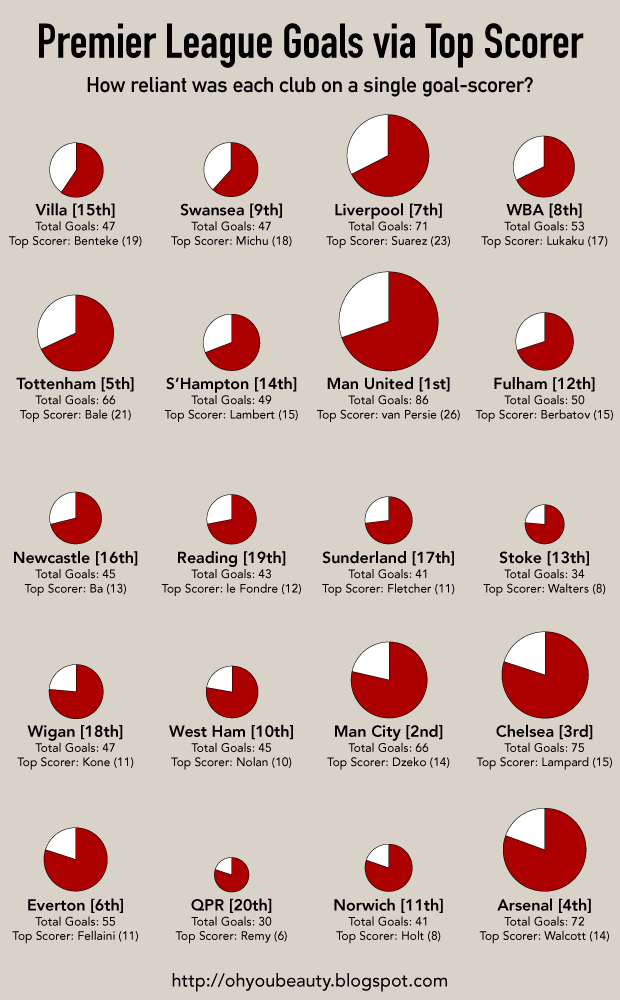
Which segues nicely into an update on this graphic from much earlier in the season, looking at how reliant each Premier League club was on a single scorer.


And the subsequent chart…


Unsurprisingly, it's vastly different to the version made after just 11 league matches. Only Liverpool, third-most reliant on one player, and Arsenal, the least reliant on one player, are in the same positions.

Just Aston Villa and Swansea got a larger proportion of goals from their top scorer than Liverpool, Benteke and Michu respectively.

The league-wide average for goals scored by the club's top scorer was 26.94% (unsurprisingly quite similar to Liverpool's average over the 21 Premiership seasons). 10 clubs were above that, 10 were below, and the average league position of the 10 clubs both above and below that mark was just about 10th.

To be fair, yes, Liverpool became much less reliant on Suarez as the season went on – more specifically, after Sturridge and Coutinho signed. Only two of his 23 league goals came in the final 10 matches, the last four of which he sat out due to suspension. Liverpool still scored 18 times during those ten matches, an average of 1.8 per game, which was just slightly less than the season-long 1.87 goals per league game average. Liverpool's record was five wins, four draws, and one loss, an average of 1.9 points per game, vastly better than the season-long 1.61 points per game average.

On March 2, Suarez was responsible for 39.6% of Liverpool's league goals. By the end of the season, that number had dropped to 32.4%. During the first half of the season, especially during the first 12 games, Suarez was single-handedly keeping Liverpool afloat in attack; he scored 64.7% of Liverpool's goals through those first 12 matches. Where, I hesitate to remind, Liverpool averaged just 1.25 points per game and were sat in the bottom half of the table.

As Liverpool grew as a team and added more key attackers, Liverpool did a much better job spreading the wealth. In those last ten league matches, Sturridge scored six; Henderson three; Coutinho, Gerrard, and Suarez two; and Agger, Borini, and Downing once. Which bodes well for next season, whether or not Luis Suarez remains with the club.

Still, let's not pretend that Suarez's exit would be anything other than a monumental change.

12 March 2013

Luis Suarez – The First 50 Goals [Infographic]


• According to club statistician Ged Rea, only eight Liverpool players reached this total in fewer games. I did a quick chart of the big names when Torres hit the mark a few years back, but didn't know to include the fastest to 50: Albert Stubbins, who did it in 77 matches. Suarez was also outpaced by Roger Hunt, Torres, Rush, and Aldridge, but scored 50 goals faster than Owen, Fowler, and Dalglish, among others.

• Suarez has faced 19 clubs at least twice. He's only failed to score against one of those 19 – West Brom. Damned West Brom. Those two losses are going to haunt me for a while, no matter where Liverpool finish in the table.

• The longest Suarez went without scoring was six matches, between goals against Wigan on November 17 and Fulham on December 22 this season. Yes, his longest scoring drought – at least in matches where he played; not counting those during his lengthy suspension – came this season. And right before that six-match drought was his longest consecutive scoring streak, five matches, against Everton, Swansea (League Cup), Newcastle, Chelsea, and Wigan. He'd tie that mark with a goal against Southampton on Saturday.

• Suarez has scored in 21 of the 39 matches he's played this season. With 29 goals in all competitions, he's averaging a goal every 1.34 matches.

• Liverpool have earned 1.66 points per game since Suarez joined the club at the end of January – 114 matches: 54 wins, 27 draws, 33 losses. But when Suarez scores, Liverpool averages 2.15 points per game: 25 wins, nine draws, five losses.

• However, only seven of his goals were "game winners" – against Wolves, Stoke (FA Cup), QPR (twice), Norwich, Wigan, and Mansfield Town. 25 of his goals were scored when Liverpool were already ahead, 12 gave Liverpool the lead, 10 were equalizers, and only three were consolations.

• And there's a flip side to the points-per-game when Suarez scores statistic. Suarez hasn't featured in 23 of those 114 matches, and Liverpool's record in those games is 14W-4D-5L – an average of 2.00 points per game – although the caveat is that 12 of those games were cup matches, often against inferior opposition where Liverpool felt safe leaving him out. You may remember that he was suspended for almost all of those other absences.

More meaningfully, in the 52 matches Suarez has played but hasn't scored, Liverpool's record is 15W-14D-23L. Which is an average of 1.13 points per game. That's not good.

Given how the first half of the season went, that shouldn't be very surprising. Frightening, yes, but not surprising. All too often, Liverpool were desperately reliant on Suarez's goals. That seems to have eased with the additions of Sturridge and Coutinho and Liverpool's improvement as Rodgers' style becomes more familiar, but the last match Liverpool won without a goal from Suarez was the 3-2 win at West Ham. On December 9. When he was suspended.

Chances are, Suarez will continue to score goals. Probably not at the superlative rate we've seen this season, but he will produce. He is an exemplary footballer, one of the best in the league and the world. As we've incrementally seen as the season's gone on, Liverpool need to continue building a quality side around him.


If you want to see the full list of his goals, here's a Google Docs version of my spreadsheet.

16 January 2013

On Suarez and Sturridge Against United

45 minutes is a piss-poor sample size, but there were some clues as to how Liverpool's new signing will link up with Liverpool's star player.

Heat Maps via Squawka:


Pass Combinations:


Overall Second Half Passes:


Both Suarez and Sturridge dropped deep, drifted wide, and spent time in the penalty box. Suarez actually spent less time on the flanks than in the first half, when he was supremely isolated in United's half, trying to find some way to have an effect. No matter the formation, both showed a willingness to switch roles, as well as the adaptability to do it successfully, despite never having played together in a competitive match.

Two of Sturridge's nine passes to Suarez were chances created: a layoff in the right channel which led to a blocked shot just before the move for Liverpool's goal and a ball over the top from the left for Suarez's tame header in the second minute of added time. One of Suarez's five to Sturridge created a chance: a long diagonal from right to left that led to Sturridge's shot into the side-netting in the 70th minute.

A fair few of Sturridge's passes came from the left channel, more of Suarez's passes came from the space between the lines in the middle of the pitch, much as you'd expect from an "orthodox" attacking #10. And, yes, I'd be remiss if I didn't mention that Sturridge made almost twice as passes to Suarez as vice versa and completed more passes in total in the second half. He actually passed to Suarez in the penalty box twice. Daniel Sturridge! I know, right!

That Liverpool basically played 4-4-2 (or 4-4-1-1; it wasn't 4-3-3, it wasn't really 4-2-3-1 either with Downing and Borini playing deeper than Suarez) meant that neither Sturridge nor Suarez really had to drift to the channels to defend or track back. Both Borini and Downing mostly stayed wide (one to better effect than the other).

This probably won't be the formation going forward, unless Rodgers tries to adapt his 4-2-3-1 for Suarez to feature as the #10. The Uruguayan would play the role very differently than Henderson, Allen, Gerrard, or Şahin. Shelvey might be the closest example; see his heat maps against Fulham and Stoke (primarily Fulham) last month. But Shelvey still dropped deeper, more involved in the midfield whether Liverpool were in or out of possession, than Suarez ever will. Or should be. And it might create even more problems in midfield, where Liverpool are already struggling to find the right blend of Lucas, Gerrard, Allen, and Henderson.

Nonetheless, as others have said, the way the two forwards linked up, joined by Borini just after the hour mark, looked promising. There were signs that both can play centrally or either can shift to the flank. Those 45 minutes against the league leaders, where the league leaders were on the back foot on their own ground, demonstrate that – as hoped – Sturridge and Suarez could well be versatile enough (and clever enough) where their starting position truly doesn't matter.

20 August 2012

On Suarez and Gerrard at West Brom

"Even if Liverpool gets better production from the supporting cast – and honestly, there's seemingly nowhere to go but up in that category – as [Suarez and Gerrard] go, so goes Liverpool."

I hate being right.

And yesterday, in the first match of the league campaign, Suarez misfired and Gerrard had little influence on proceedings, and Liverpool failed to take advantage when in control then succumbed to a wonder goal followed by multiple defensive errors and a sending-off. We're all well aware it's the not first time that's happened, and it most likely won't be the last. Agger and Skrtel's mistakes, Downing and Borini's ineffectiveness, and Phil Dowd being Phil Dowd also played a large role in Liverpool's inadequacy, but it sure felt like the rot started at the top.

Suarez's shooting


That's abhorrent accuracy, and yet Suarez was the only Liverpool player to put a shot on target. All three of Gerrard's were off target, while Borini, Cole, Downing, Johnson and Kelly took one and missed one. Two of Suarez's shots, the two off-target from inside the six-yard box, were clear-cut chances, errant headers from Johnson and Borini's excellent crosses. The first, mistiming his jump for Johnson's cross after good work from the stand-in left back on the half-hour mark, sure felt like a turning point when West Brom opened the scoring 13 minutes later.

But this is nothing new. Suarez had one of the worst clear-cut chance conversion rates in the league last season.

Opta's definition of a clear-cut chance:
A situation where a player should reasonably be expected to score usually in a one-on-one scenario or from very close range.
Suarez converted seven of his 25 clear-cut chances last season – 28%. Rooney? 17 of 29 (59%). Agüero? 13 of 27 (48%). Van Persie? 18 of 40 (45%). But those were three of the league's best finishers. However, this EPL Index chart (from this article) lists 33 attackers; just six had a worse conversion rate: Bendtner, Bale, Carroll, Defoe, Gervinho, and Kuyt. The league average was 39%; had Suarez converted at that rate, he would have scored three more goals last season.

His shooting accuracy against West Brom was even worse than last season's abysmal return. 48 of his 128 total shots in 2011-12 were on target – 38% – compared to yesterday's 25%. He took eight or more shots in just one match, with 11 in the 1-1 draw against Norwich (the most any player took in a Premier League match last season), and at least tested Ruddy with six of those 11 even if he didn't score, including one near-miraculous save in the fifth minute of added time to preserve the draw.

Dan Kennett wrote extensively on this topic for The Tomkins Times back in March, and his findings remain relevant.

There will be matches where Suarez's is unerring, where Suarez scores in style early and often. Unfortunately, after 54 matches for Liverpool, those like his hat-trick against Norwich have become the exception rather than the rule. Admittedly, it's slightly easier to forgive missed chances when the player creates so many of the chances by himself. But his two best opportunities yesterday came from crosses put on a plate by Johnson and Borini, and he failed to hit the target on either.

I'm not necessarily saying that Suarez needs to be used differently, especially this early into Rodgers' reign. There's the temptation to demand he plays wide, not used as the main goal-scorer, which will only increase if this trend continues. And his talents might serve Liverpool just as well, if not better, on the flank. But his ability to run off the shoulder of the last man, to drag defenders out of position with his movement or with the ball at his feet, and his ability to involve others in the attack seem suited for his current role. He played on the flanks more often at Ajax, but it's no coincidence he's also become the central #9 for Uruguay since joining Liverpool.

However, if Suarez is going to play as a #9 in Rodgers' system, even if a roaming #9, a #9 as focused on creating as much as scoring, he needs to better that scoring return. And quickly.

Gerrard's passing


56 passes attempted, 46 completed. Just 17 passes into the attacking third, completing 12, with only one incomplete pass inside the penalty area.

Allen, Lucas, Suarez, Johnson, and Borini all completed more passes in that crucial area of the pitch. Gerrard's completion percentage in the final third was 71% – only Downing (7/10), Skrtel (1/5), and Reina (0/2) were less accurate, and both Skrtel and Reina were limited to long hoofed passes from their own half. Agger's red card started from one of those five unsuccessful attacking third passes, the mistake compounded by losing possession with so many Liverpool players in West Brom's half, as both Allen and Lucas went forward when Gerrard dropped deeper to receive possession.


Gerrard's overall pass completion percentage from open play was 82%, the worst of any outfield Liverpool player. And it's not as if the sending-off made him any less accurate, pushing too hard to try to haul Liverpool back; he was 27/33 when Agger went off, again, 82% completed, with nine of 11 successful in the attacking third but none of those 11 into the penalty box.


Gerrard also created two chances against West Brom – only Glen Johnson created more, with three – but both were fairly poor excuses for chances. The first, in the 50th minute, was when he spread play wide to Downing, with the winger running into traffic then taking an easily-blocked shot. The second came after Liverpool were down to 10 and down by two goals, in the 72nd minute, when he spread play wide to Cole, with the winger running into traffic then taking an easily-blocked shot.

There was little of the one-touch quick passing with Suarez, Borini, and Downing that caused so many problems against Gomel and Leverkusen. Gerrard passed to Suarez just five times; Allen and Kelly was Gerrard's most frequent targets, receiving eight and seven passes respectively from the captain. On the other hand, Suarez set Gerrard up 11 times – only Kelly to Skrtel, Johnson to Agger, and Agger to Johnson were more frequent combinations – but just one of those passes came inside the penalty area and just two were forward passes, one in the center circle and one where Gerrard burst forward from midfield ahead of the ball, as has been so crucial in the past.


And his crosses? Six attempted, zero successful. Borini also attempted six, but at least completed one – that one clear-cut chance for Suarez – while no other player attempted more than four. Incidentally, Liverpool delivered 22 crosses in total – they averaged 22.1 per match last season, the most in the league – but completed just three, a success rate of 14% where they averaged 19% in 2011-12. Needless to remind, but it was not a very successful tactic last season.

Moving Gerrard into a more attacking position was supposed to make him more influential, but he couldn't have been much less so on Saturday. Still, days like that will happen; time makes fools of us all and whatnot. But even when that happens, Gerrard's leadership and mentality remain vital qualities. They are more intangible qualities, but as captain, it's Gerrard's job to ensure heads don't drop and Liverpool keep playing after setbacks like Agger's red card or the second penalty. But Liverpool looked beaten as soon as West Brom's second went in; the last 25 minutes weren't even damage control, but playing out the clock, and it was little surprise that West Brom added a third. It wasn't the first time a team crumbled to dust after a sending off and it won't be the last, and, of course, a comeback was massively unlikely. But you never want to see the players look as if they believe that. All too often, Liverpool rolled over and died at the first sign of trouble last season. That trait cannot carry over into this one. Taking responsibility in an interview today, for the first penalty concession if little else, is a reassuring step, but words are far easier than deeds.

During this transitional phase with a new manager and a new system, Liverpool will rely on its established stars to carry them through difficult spells. It may not necessarily be fair to hold them to a higher standard, but it's warranted. Despite all else that occurred against West Brom – Dowd's decisions, Agger and Skrtel's penalties, inefficient flank play – when both Suarez and Gerrard disappoint, it's no surprise that Liverpool loses.

30 April 2012

Better Performance, Worse Results

Saturday's match was pretty much all the proof we need. It really is all about finishing.

Liverpool have played "better" than they did against Norwich in numerous matches. And it's usually, somehow, led to worse results. Suarez tallied three world-class goals – and that term isn't used lightly – three superlative finishes, each more impressive than the last. Two will probably show up on the end-of-season Top 10 goals list. And that's the sole difference between the comfortable three points and yet another frustrating draw.

Otherwise, it was a fairly pedestrian performance from Liverpool, one which wasn't wholly unexpected given where we are in the season and what's come before. And admittedly, Norwich's poor defending played a role in two of the three goals, if not all three. But aside from those three spectacular strikes, Liverpool were typically profligate: a couple misses from Suarez, Shelvey's header off the bar and bobbled point-blank strike, Downing's right-footed shot smartly saved (not to mention the numerous blind alleys he ran directly down).

As always, statistics provide just a small snapshot, but here's a brief comparison with ten of Liverpool's most disappointing matches where they've played "better" but taken fewer points.


Fewer shots in nine of the ten – on target, off target, and blocked – and less possession in six of the ten. The differences in chances created – yes, that statistic again – is the most conspicuous. That statistic seemingly defined last summer's transfer business; we all remember the ubiquitous chart showing Adam, Downing, and Henderson in the top 10 for Premier League chances created. Well, this is where it's gotten us. And where it's gotten the architect of last summer's transfer business.

According to StatsZone, the source of all of these statistics, Liverpool have created 443 chances this season, an average of just under 13 per match. And have scored just 43 league goals. Which is the fewest in a season since 1776 or something. Liverpool created just eight chances against Norwich and scored three goals. None of those chances were clear-cut, by any definition. The team created fewer chances in just four league matches this season – 0-4 at Spurs, 2-1 at Chelsea, 1-2 at United, and 0-2 at Newcastle. And yet, Liverpool still won handily on Saturday against a side they frustratingly drew with at Anfield.

Yes, Liverpool have had other problems, repeatedly discussed at length here, there, and everywhere. Inconsistent performances, inconsistent tactics, questionable purchases, key players missing for long stretches. Everyone has their favorite scapegoat. Football is rarely explained by a singular success or failing.

Incidentally, Liverpool used a range of different formations and personnel in the above matches. 4-4-2 with Suarez and Carroll, 4-4-2 with Suarez and Kuyt, 4-2-3-1, 4-3-3, even 3-4-2-1. Carroll/Adam/Downing/Henderson have played well/poorly in wins, draws, and losses. Some matches saw egregiously unlucky own goals, egregiously stupid defensive mistakes, and/or penalties not given. Every attacker in Liverpool's line-up has missed chances in multiple matches, often by hitting the five-inch-wide frame of the goal. But when just one player's finishing is clinical – and Suarez was supremely clinical against Norwich – the rest of the attacking statistics don't really matter.

As wonderful as Suarez's match-winning display was, his time at Liverpool shows that we can't depend on it. He's a genius, but – like the rest of the side – an inconsistent genius, made more inconsistent by the audacious tricks he often attempts. He's had more and better opportunities in multiple matches and failed to take them. Against Norwich, his two easiest chances were the two chances spurned: his mis-kick of Downing's cross blocked in the six-yard-box and his chip over the keeper and bar after nutmegging yet another defender. There's a chance this display could prompt a run of form similar to his seemingly ever-present impact when playing for Uruguay, but chances are he remains frustratingly erratic. Similarly, his most-frequent strike partner has been better coming deep to win headers, setting up others rather than seizing on chances of his own. But again, everyone – everyone, everyone, everyone – is guilty of Liverpool's most despicable crime.

This is news to absolutely no one who's watched more than half-an-hour of any Liverpool match this season. I would like nothing more than for the Suarez-Carroll partnership to be dependably prolific, but on eight months of evidence (12 if you go back to last season), it's not happening. That doesn't mean Liverpool should sell either (I've made, and will continue to make Carroll excuses due to his age and Liverpool's set-up for the foreseeable future). But it should ensure that Liverpool's most important business this summer is to find a striker capable of consistently finishing all those created chances.

04 April 2012

2011-12 Turning Points


Lucas Injury
• 1.77 points per game before, 1.05 after [-0.62 PPG]
• 1.31 goals per game before, 1.05 after [-0.26 GPG]
• 0.92 goals conceded per game before, 1.11 after [+0.19 GCPG]

Suarez Suspension
• 1.72 points per game before, 1.40 during [-0.32 PPG]
• 1.17 goals per game before, 1.40 during [+0.23 GPG]
• 0.78 goals conceded per game before, 1.40 during [+0.62 GCPG]

Carling Cup Final and Agger Injury
• 1.56 points per game before, 0.50 after [-1.06 PPG]
• 1.16 goals per game before, 1.17 after [+0.01 GPG]
• 0.92 goals conceded per game before, 1.67 after [+0.75 GCPG]

All three are terrifying, but the effects of the Carling Cup final hangover and, more importantly, Agger's injury are by far the scariest. Liverpool have only played six league matches since, but are averaging a point less per game and conceding 0.75 more goals per game. Having Johnson and Kelly absent for most of those certainly hasn't helped, but Agger is the the biggest miss. Skrtel may have been Liverpool's player of the season – at least before this recent stretch – but Daniel Agger is by far Liverpool's most important defender. As Bass Tuned to Red wrote earlier this week, Liverpool have conceded a league goal every 129.7 minutes with Agger on the pitch, and a league goal every 58.9 minutes when he has been absent. Yikes.

Lucas' injury is almost as significant. Liverpool's record in the 13 games prior to his injury: 6W-5D-2L. Liverpool's record in the subsequent 18: 5W-4D-9L. Fewer goals scored per game and more goals conceded, although it's slightly surprising to see a bigger difference in goals scored rather than conceded. But Lucas' as the metronomic base for Liverpool's attacks is just as important, if not more so, than Lucas as the tough tackling defensive midfielder.

Finally, Suarez's suspension. Five matches, from Newcastle at home through Wolves away, returning as a substitute against Tottenham. Liverpool actually scored more goals per game during the matches Suarez missed. Carroll started as a lone striker in three: the two matches where Liverpool scored three – wins against Newcastle and Wolves – as well as the 0-3 loss at City. Carroll and Bellamy partnered in the loss at Bolton, linking up for the lone goal, while Kuyt started up front in the 3-4-2-1 scoreless draw against Stoke. However, Liverpool's goals conceded tally rose dramatically during that span, mostly thanks to conceding three against City and Bolton, both featuring Liverpool's first choice back four of Johnson-Skrtel-Agger-Enrique. It's hard to credit that to Suarez's absence, but I suspect (without proof) that opponents are more hesitant to send multiple attackers forward with the ever-dangerous Uruguayan lurking off the shoulder of the last defender.

Missing key players for long to extra-long stretches isn't a good enough excuse for this season's horrors. Liverpool still scored too few goals, conceded frustratingly in aberrant draws, and found new and inventive ways to drop points before any of these three turning points. However, all three absences, as well as the post-Carling Cup letdown, do help explain the increasingly diminishing returns during this horror campaign.

06 December 2011

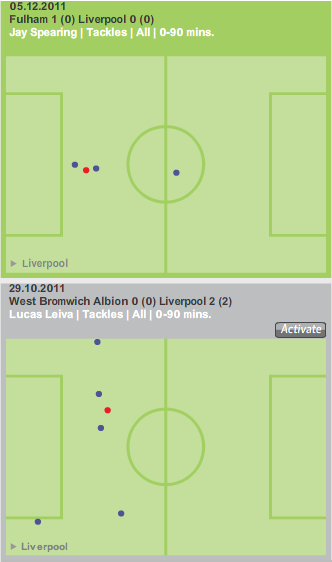
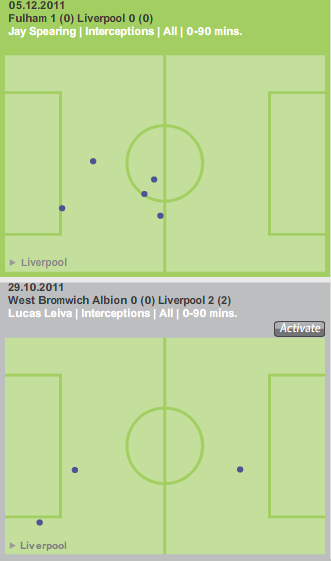
On Suarez and Spearing's Positioning

Lucas' absence and Liverpool's subsequent change in formation altered the position of two of Liverpool's key players against Fulham: whoever the holding midfielder is and Luis Suarez.

Jay Spearing often played further up the pitch than Lucas usually defends, while far more static in general. The 4-3-3 formation, with Carroll as center-point and Suarez and Bellamy lurking on either side, meant Liverpool's talismanic Uruguayan took up positions further from goal.

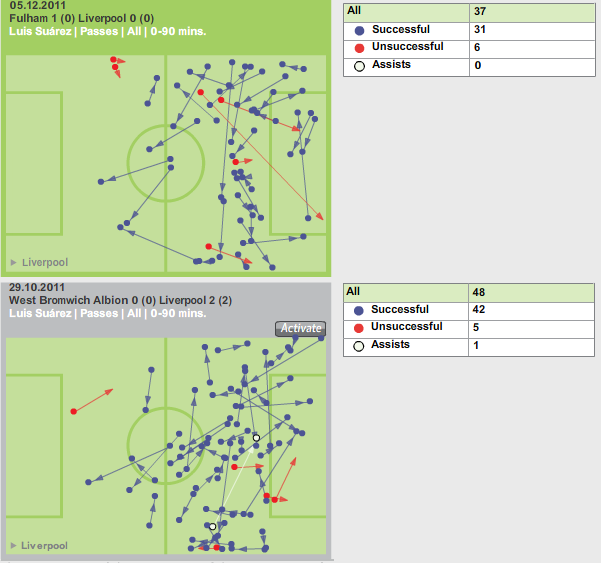
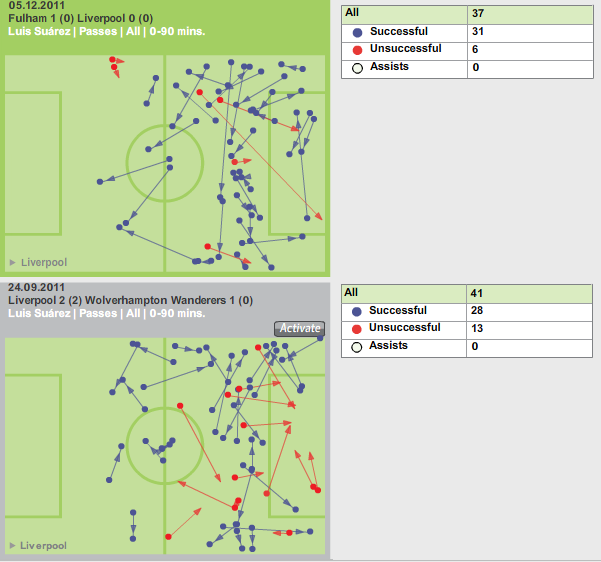
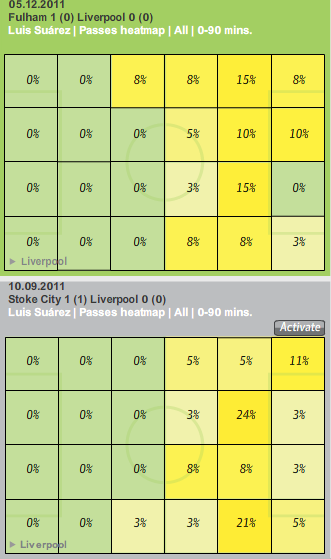
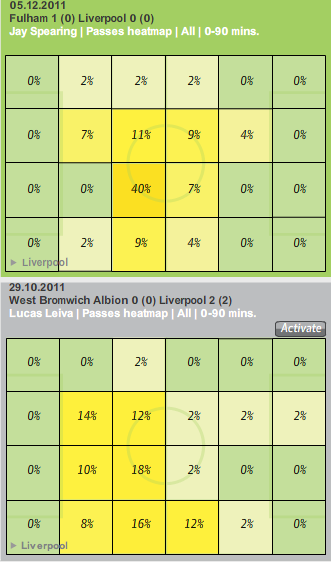
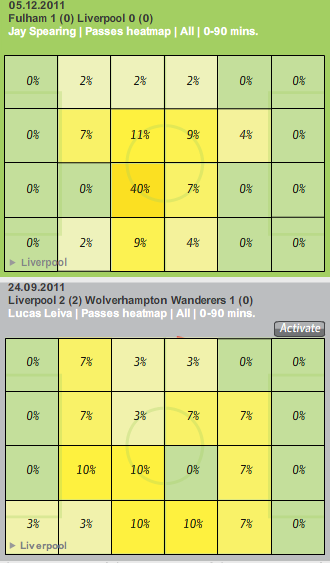
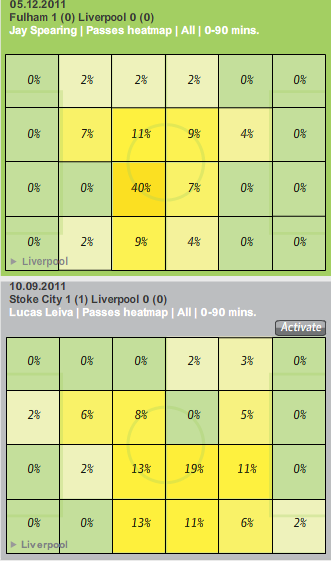
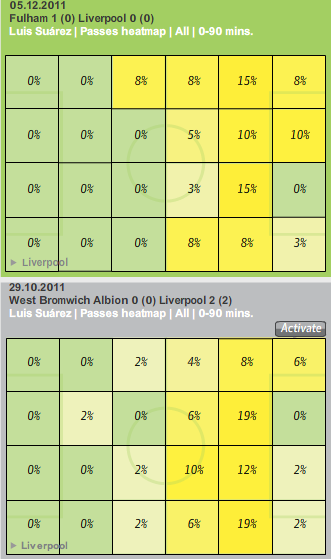
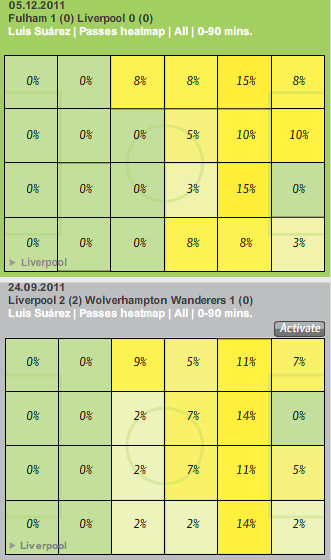
I'm using West Brom away, Stoke away, and Wolves at Anfield as points of comparison in chalkboards below. As said in yesterday's review, I think West Brom is the strongest parallel except in finishing – similar opposition playing style, away from Anfield, and with Carroll and Henderson starting. Stoke away is comparable in result, losing despite domination, while Wolves at home was another where Liverpool's performance disappointed but the side ground out a result due to taking its chances early on. The possession, passing, and shot statistics against Fulham are relatively similar to those against West Brom and Wolves; the result is the same as that against Stoke. If anything, stats from Stoke and Fulham – the two losses – look "better" than those against Wolves or West Brom.

As usual, click on the chalkboards to make them pop-up full size.

Suarez


The chalkboards and heatmaps against Fulham show Suarez making more of his contributions further from the penalty area, whether deeper centrally or spending more time on the flanks. He attempted the fewest passes from these four matches against Fulham, and his performance is especially disappointing in comparison to that at West Brom – where he won the penalty and set up the second goal.

Suarez was widely known as a wide forward with Ajax before coming to Liverpool, but he's played as an out-and-out striker in almost every match under Dalglish, and is now playing a similar role with Uruguay (see Zonal Marking's Copa America reports, among others). His performance in a three-man front, an admittedly unfamiliar role at Liverpool, left much to be desired.

Update: Should have included take-ons as well. StatsZone chalkboards from Fulham (1 successful, 5 total), West Brom (3 of 6), Wolves (4 of 9), and Stoke (4 of 12).

Spearing


Unlike in Suarez's case, the amount of passes played seemed less important than the location, so I'm just including the heatmaps. That 40% zone stands out like a Las Vegas neon sign, surprisingly static, and further forward than Lucas usually plays. There was less movement in Liverpool's midfield without the Brazilian, as well as more space between the holding midfielder and back four, allowing more shots from distance than Liverpool regularly permits.

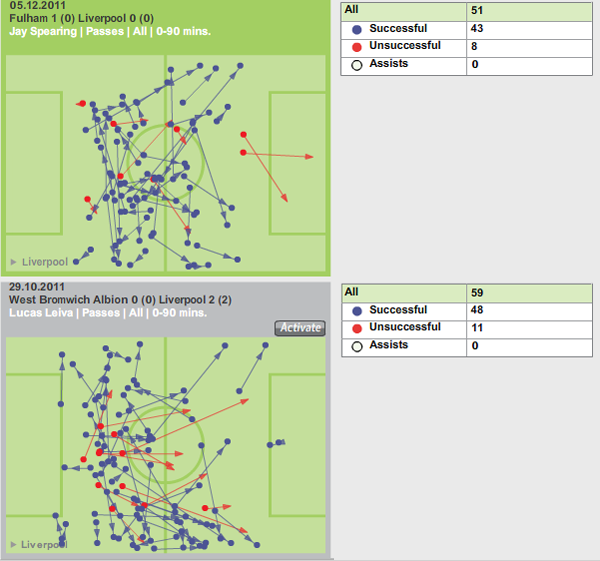
More chalkboards from Spearing at Fulham compared to Lucas against West Brom:


Spearing's tackles all occurred in the center of the pitch and most of his interceptions are in the same zone where 40% of his passes came from. Filling in for Lucas is a weighty burden, and it's a new role without a Brazilian safety net. Lucas partnered Spearing in all ten of the Liverpudlian's starts under Dalglish last season and in three of four prior to Fulham this season; Spearing with Adam in a 4-2-3-1 against Exeter had been the lone exception.

To be fair, Dalglish may have shifted to a 4-3-3 because of the opposition or to try to use Carroll, Bellamy, and Suarez at the same time, rather than because of Lucas' absence. Given how rarely we'd seen the formation – at Spurs was the only other time this season by my count, and that didn't last long; incidentally the only other time Liverpool's incurred a red card this season – some struggles are to be expected. But at the first time the question's asked, it's frightening evidence that Liverpool will miss Lucas Leiva very, very much.

27 October 2011

Goal Breakdown: Suarez 1-1 Stoke


Nothing, absolutely nothing, can take away from the sheer, singular brilliance of Suarez's swirling strike, but I wanted to highlight the contributions of those involved in the build-up, specifically three off-the-ball runs and two cross-field passes. Mostly to ensure they don't get lost in the utter majesty of the finish.

In case it isn't clear, in the above chart solid lines represent passes, the black dashed line is Agger striding forward in possession, and the red dashed lines are the player's movement off the ball following their pass.

Henderson, ostensibly the right-sided midfielder, comes inside to start the attack after Liverpool successfully defended a Stoke free kick (it was Lucas who won possession). After correctly spreading play to the full-back, Henderson follows Agger's run instead of retreating to the right flank. And having followed Agger's run, he's perfectly placed to draw Robert Huth (who's initially marking Suarez) away from the Uruguayan with a sprint to the byline, leaving Suarez one-on-one with the unfortunate right winger Shotton.

Meanwhile, Agger's continued going forward after setting up Maxi, getting into the box despite being a center-back pushed out to the left, but smartly retreating when the early cross didn't come. And at the same time, Maxi joined him in the penalty area after quickly passing onto Kelly, occupying the right-sided center-back Shawcross to ensure he didn't double up on or close down Liverpool's eventual scorer.

And we can't sell two brilliant cross-field balls short of credit. Maxi's to Kelly, shifting play from left to right, opened up the space for Henderson, Agger, and Suarez's runs. Spearing's from deep was pinpoint to Suarez drifting out wide, deftly weighted and easily controlled.

This goal, regardless of the necessarily wondrous finishing touch, is the epitome of both pass and move football and a fluid formation where numbered notation and starting position mean next to nothing.

When done correctly, it creates unwanted chaos for the opposition, requiring defenders to leave their planned marker, not necessarily sure who to pick up. The quick passing between Maxi, Kelly, and Spearing – two of three long in the air – ensures the defense has to chase, unable to settle into the preferred default shape. Henderson, Agger, and Maxi were comfortable enough to leave their required roles, demonstrating some of the intuitive attack we've been hoping for, seen so often in last season's big wins. The problem is that is not easy to build that intuitive understanding, especially with a fair amount of new signings over the summer. This goal is an apt demonstration of Liverpool's undeniable potential, in both creation and finish.

More of that please. And more heart-stopping, jaw-dropping, different class finishes from Suarez wouldn't be too bad either.

Liverpool Offside has video of the goal if you'd like to relive it in a more visual manner.

24 October 2011

Image of the Day


Nine games. 39 shots: 17 on target, 16 off target, six blocked. Four goals. That's an awful lot of shots without much return. Which seems to be the story of Liverpool's season so far.

This isn't to criticize Suarez. More often than not, especially against Norwich, he's looked the only one capable of magic, capable of somehow hauling Liverpool to three points. On Saturday, he created chances from absolutely nothing at least twice, somehow turning away from defenders in a phone booth-worth of a space, only to hit the frame or see Ruddy make yet another unexpected save. He is undoubtedly Liverpool's best and most important player, no matter Lucas' essential holding, no matter Gerrard's talismanic capacity, etc. Nonetheless, his 11 shots against Norwich – six on target, four off, one blocked – are the most without scoring for a single player in a Premier League game since Ronaldo did similar almost five years ago.

Yesterday, Dan Kennett wrote an outstanding look at Liverpool's chance conversion, game-by-game and compared to opponents and rivals. Needless to say, it's not pretty.

Sometimes it's worthwhile to dissect matches with chalkboards, tactics, and pseudo-scientific divination. Sometimes over-analyzing really is over-analyzing. Take chances, take the points.

The overall shots statistics for all Liverpool players through these nine games follows.