28 June 2012

Germany 1-2 Italy

Goals:
Balotelli 20' 36'
Özil 90+2' (pen)

The Mario Balotelli show. Mario Balotelli, and Italy's defense. The more things change...

This time, Jogi Löw's personnel switches didn't work. Gómez and Podolski returned to the starting XI, along with Kroos, going with experience and Kroos' extra effort in midfield in an obvious effort to stifle Pirlo. All understandable changes, even if I'm perpetually dubious of Podolski, but needless to say, it did not work as planned.

But before Super Mario could save the Princess, Pirlo had to clear a corner off his goal-line, while Buffon parried a cross onto Barzagli, trickling behind the goal rather than into his own net, then saved a fierce shot from Kroos. Italy lived dangerously for the first 15 minutes, but then punished Germany's profligacy with supreme finishing of their own.

There were individual errors we can point to on both goals, but that takes nothing away from the creation or execution of either. For the first, Hummels was beaten too easily by Cassano's ballet, a wonderful spin and cross with his weaker foot, while Balotelli effortlessly out-jumped Badstuber for a bullet header. 16 minutes later, after yet another failed German corner, Italy immediately transitioned to attack through Montolivo's long pass, with nearly every German defender still in Italy's half. Balotelli's run was perfectly timed, splitting Podolski and Lahm, the former stepping forward with the latter playing Balotelli onside. Neither – nor Schweinsteiger – could recover, as Balotelli's sprinted towards Neuer before unleashing an impossible, unstoppable, utterly perfect shot. Those two completely different but similarly jaw-dropping strikes aptly demonstrate why both Manchester City and Italy put up with his less productive antics.

Löw attempted to rectify his errors with two half-time substitutions, replacing Gómez and Podolski with Klose and Reus. But, thanks to the two-goal lead, Italy's defending was the second half star. This wasn't your father's Azzurri, wholly reliant on stingy catenaccio, but the Italians still had an answer for every question Germany asked, vacuuming up pressure before launching counter-attacks.


Germany started the second half almost as brightly as the first, but Lahm shot over after a one-two with Kroos, Italy's swarming defense ensured Khedira couldn't fashion a shot after Özil's burst to the byline, and Buffon brilliantly saved Reus' vicious dipping free kick.

From there, and until Germany's late penalty, Italy looked the more likely to notch the game's next goal. The Germans may be renowned for their counter-attack, but Italy were nearly as effective thanks to Germany's increasing desperation, in everything but the finishing. The finishing was what separated the first and second halves, what separated today's performance from the quarter-final struggle against England.

Diamanti, on in place of Cassano in the 57th, was at the center of the first two chances, releasing Marchisio twice, but the midfielder screwed his shot across the face of goal both times. Di Natale beat Germany's offside trap in the 82nd but shot into the side-netting; Balzaretti had the ball in the net a minute later but was offside. Throwing the kitchen sink finally paid off in injury time with a soft penalty for a Balzaretti handball, Özil notching the spot kick, but it was too little, too late, an unlucky blot on an otherwise-spotless Italian record.

Once again, Cesare Prandelli out-coaches his opponent. Italy's tactics were flawless, and fully merit the victory. Pirlo was rendered less influential by Germany's midfield, but others – specifically De Rossi and Montolivo – compensated. The new back four, with Chiellini returning at left back, shifting Balzaretti over to the right, worked to perfection. Germany were unable to take advantage of Chiellini out wide because of Kroos and Özil's focus on playing in the middle, while Balzaretti was able to cancel out Podolski then Kroos as an "inverted" fullback against players who specialize in cutting in from the flank. Ignoring the temptation to remove Bonucci or Barzagli in favor of Chiellini allowed those two to continue their excellent pairing, neither giving Gómez or Klose a glimpse all game.

Now, we get a replay of the first match in Group C. Spain versus Italy. Can Spain win its third tournament in a row, something that hasn't been done since the 1930s? How will Del Bosque avoid using an out-and-out striker this time? Why are Italy always so much better at tournaments after a Serie A scandal? Will Prandelli revert to the three-at-the-back which stifled Spain for long stretches or continue to dance with what brung them? Can Balotelli do that or that again?

Someone has to win this meeting. Sunday can't come soon enough.

27 June 2012

Spain 0-0 Portugal aet

Spain win 4-2 on penalties

Penalties
Spain: Alonso, Iniesta, Piqué, Ramos, Fàbregas
Portugal: Moutinho, Pepe, Nani, Bruno Alves

The king still lives. But barely.

"You come at the king, you best not miss." And Portugal had zero shots on target. Zero. 11 efforts: eight off-target, three blocked, all but three from outside the penalty box. Which admittedly, wasn't much better than Spain's two on target from eight until extra time – where they were markedly improved – but Spain's been here, done this before, and have the t-shirts and trophies to prove it.

Sure, after 90 minutes, Spain were as unimpressive as at any time during their run through the last three tournaments. At full time, Spain had completed just 469 of 553 passes, both lows for this tournament. As was the resulting 85% pass accuracy, after 89% against Italy, 92% against Ireland, 89% against Croatia, and 89% against France.

Credit for much of that goes to Portugal, although some was self-inflicted (*cough Negredo cough*) and some was the valid "two days less rest" excuse. But Portugal were outstandingly diligent in midfield; Veloso, Moutinho, and Meireles took turns pressing Spain's engine room, ensuring neither Xavi nor Xabi (nor Iniesta when he dropped deeper) had time to create anything. Portugal's back four has been one of the tournament's best, and Pepe and Bruno Alves remained excellent, while Pereira limited Iniesta and Alba more than any other right back has been able to so far.

Still, Del Bosque's gamble, starting Negredo instead of Torres, Fàbregas, or – god forbid – Llorente, was an utter failure.


He had absolutely zero impact in 54 minutes, unceremoniously hauled off in favor of Fabregas soon after the interval. Regardless of the usual superiority in possession, which was slightly less superior than usual, Spain were limited to one clear cut chance in the first half. The first was from the usual player left free – Arbeloa, typically Spain's least potent threat and unsurprisingly rarely tracked by Ronaldo – but he ballooned his ninth-minute shot from Negredo's cutback. Otherwise, Iniesta had a couple of off-target efforts after linking up with Xavi and Alba, while Portugal fed off whatever scraps Ronaldo self-created, with Almeida much less menacing than against the Czechs.

The second half remained in a similar, yawn-inducing vein, even after Fàbregas replaced Negredo, shortly followed by Navas in place of Silva. Once again, Del Bosque sent on a tricky, cross-happy winger after taking off his "orthodox" striker. It was even less effective than against Croatia, where Navas and Fàbregas combined for the winner at the death. Still, as always always always seems to happen, Spain clawed further and further up the pitch as the opposition tired. Pedro replacing Xavi in the closing seconds, with Iniesta shifting to the play-making central role, exacerbated the gap.


As FourFourTwo amusingly pointed out, Portugal were even worse in extra time than England were against Italy. England! Interplay between Alba and Pedro led to Spain's best chance of the match late in the first half of extra time, with the left-back – Spain's star player today, and arguably throughout the tournament – breaking past three to the byline and cutting back for Iniesta, but Rui Patricio smartly saved the midfielder's placed shot.

With Spain unable to break through a determined Portugal defense despite the vast improvement in the final thirty minutes, we got penalties for the second match running. And there were more than a few similarities to the England-Italy spot-kicks. Level after Alonso and Moutinho missed while Iniesta, Pepe, Piqué, and Nani scored, up stepped Sergio Ramos, with a Xerox copy of Pirlo's Panenka straight down the middle. Once again, psychology works. Once again, the next penalty taker – Bruno Alves – cannoned his effort off the crossbar. Fàbregas scored the fifth, just like he did to beat Italy at Euro 2008, with cameras immediately focusing on Ronaldo, left standing, lip quivering, unable to even have a chance at being the hero. The schadenfreude is overwhelming. Yes, I am a petty, petty man.

By anyone else's standards, Spain are worthy finalists, the superior side in each of their five matches. But by their own, and those we've set for them, it's another ho-hum ground-out victory, eking through thanks to a penalty lottery.

But Portugal winning would have been similar to England beating Italy. Italy were more dominant, in shots and attacking flair if not possession, while England are assuredly not at Portugal's level. Portugal – and yes, Ronaldo – had an outstanding tournament, especially the midfield and back four, and were deserved semi-finalists. But Spain were the better side, are the better side, and will now face Germany or Italy for the chance to do what no other country has ever done.

Are you not entertained?

25 June 2012

England at Euro 2012 (Statistics)

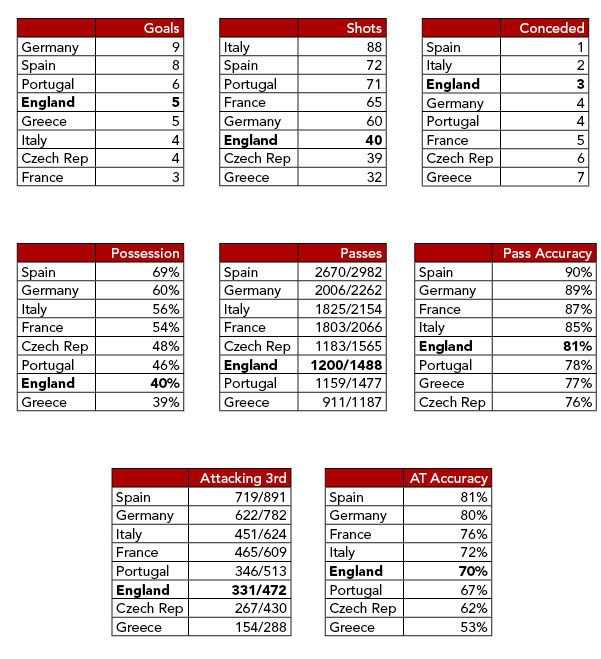
A handful of attacking statistics – combined totals after each's four matches – for the eight teams to qualify for the knock-out rounds seems an apt illustration of where England stands after the quarterfinals.


Congratulations, you're better than Greece and the Czech Republic! And a couple other countries in a couple of categories. Huzzah! It's no surprise to see Spain atop almost every category, except Germany have scored more goals (with far fewer shots) and Italy have taken more shots – which is explained by Italy's unfathomable 36 shots against England. Which is just four shots fewer than England took all tournament.

Unsurprisingly, England come off worst in possession, shots, and attacking third passes. And are above average in goals conceded. That's Roy Hodgson Football perfectly epitomized. And it's Hodgson Football when Hodgson Football works; Liverpool were assuredly below average in goals conceded, especially away from Anfield, during his reign.

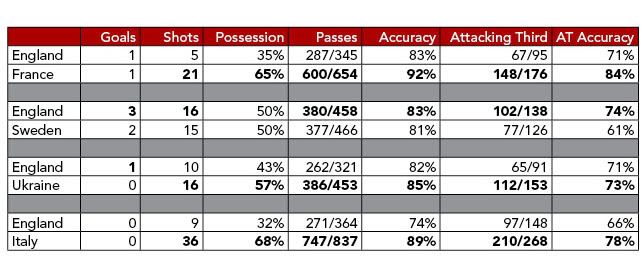
Comparing England to their opponents in each match makes for even grimmer reading.


France and Italy were better in each of these categories in the two matches England drew – ignoring the fact England actually lost to Italy on spot kicks. England were statistically better than Sweden in all of these categories save possession; Sweden only scored twice because of two out-of-character defensive errors. And England were better than the Ukraine in just one category: goals scored.

Hodgson and his apologists would argue that doesn't really matter, that it's a results-based game, and England only lost one match because of the penalty lottery. Which has some validity. Had Young's spot kick not hit the crossbar, had one more Italian missed theirs, England could still be unbeaten. Whether they deserve to be is a different question, but you often don't get what you deserve in sport.

However, the question remains whether that, and the above statistics, is good enough for England's national team. At the moment, the sad truth may be that it is.

24 June 2012

England 0-0 Italy aet

Italy wins 4-2 on penalties

Penalties
Italy: Balotelli, Montolivo, Pirlo, Nocerino, Diamanti
England: Gerrard, Rooney, Young, Cole

Sometimes there is justice in the universe. Also, don't name your male children "Ashley."

Negative football doesn't get punished often enough. And Italy, for all its possession and passing supremacy, were unable to punish England through 120 minutes. But, as usual, penalties punish England.

England made this Italy side – better than expected, decent but unimpressive – look like Spain. The first 15 minutes ended up an aberration, with England surprisingly attacking after De Rossi's early left-footed thunderbolt hit the post. Buffon somehow prevented Johnson from opening the scoring in the 5th minute, palming away the close-range effort after a nice move down England's right, Parker shot narrowly wide from the top of the box, and stellar defending from Barzagli and Abate prevented Welbeck and Rooney from getting off decent efforts. After that, it was pure HodgeBall.


Two deep lines of four coupled with a complete refusal to press the ball outside the final third. By half-time, Italy had 235 touches in the middle of the pitch to England's 79.

The most galling feature was how much license England gave Andrea Pirlo. Already one of the players of the tournament and, at age 33, a man whose abilities are well-documented, handed all the time in the world to create whatever he pleased.


Meanwhile, Gerrard couldn't make anywhere near the same impact for England, whether due to Hodgson's tactics or an inability to play four matches in 13 days. Or a combination of both.


I'm well aware he's the captain, and he'd have to be dragged from the pitch kicking and screaming, but it's criminal that Gerrard's played all 300 of England's minutes, including 120 today. To be fair, it's not as if England had many other options. And Hodgson had used all three substitutions by the 94th minute – even though Gerrard began showing signs of cramp in the 70th – first replacing Welbeck and Milner with Carroll and Walcott, then Henderson for Parker soon into extra-time, due to that player's long-standing injury. Carroll's entrance helped, more influential than the peripheral Welbeck, but removing Milner – whose stamina is his best attribute – was questionable at best.

So, how did England even stay in this match?


Last ditch defending. 13 blocks is the most from any side so far this tournament. Pack the penalty area, and make sure nothing comes cheap or easy. Which is Hodgson's trademark.


Last ditch defending and wasteful Italian shooting. Italy seemed satisfied to fire from long distance, unable to penetrate England's parked bus. Balotelli and Cassano's radars were off all match long, while England got reprieves as Balotelli (multiple times) and Montolivo missed clear cut chances. Diamanti hit the post in extra time, while Nocerino had the ball in the net in the 115th minute but was rightfully ruled offside.

Which meant that Hodgson's tactics "worked," with England making it to the penalty lottery. And it initially looked likely to pay dividends, as Gerrard and Rooney both tallied while Montolivo missed Italy's second. Then Pirlo stepped forward. His Panenka was a back-breaker, a psychological death knell, and a wonderful capstone for a wonderful player's wonderful match. Young and Cole missed England's next two penalties – the former off the crossbar, the latter easily smothered by Buffon. Nocerino, then Diamanti sealed qualification to the semi-final, yet another crushing penalty defeat for England – their seventh in the last eight attempts.

It's tempting to say "we told you so," but we told you so. This is Hodgson, for good and evil. It's ugly, it's dismal, it's overly defensive. But sometimes it works, and it also led to a better-than-expected result, a result England haven't bettered since the 1996 Euros on home soil.

Is it a long-term solution? Absolutely not. And it's indescribably painful when done without any improvement in results, as Liverpool learned. But sometimes you need your short-term medicine.

Still, I'd recommend it remain nothing more than short-term medicine.

23 June 2012

Spain 2-0 France

Goals:
Alonso 19' 90+1' (pen)

I've never seen a side as comfortably in control with a one-goal lead as this Spanish side.

Compare today with yesterday's quarterfinal. No matter how dominant Germany were, they still conceded an unlikely equalizer and had to furiously rally in the final 30 minutes. That never, ever, ever looked likely today. And France is – or, at least, should be – a far better side than the Greeks.

Not counting Ireland – because, honestly – it was the first first-half goal Spain have scored in a major tournament since beating Chile in the last group stage game of the 2010 World Cup. Goals against Croatia, Italy, Holland, Germany, Paraguay, and Portugal all came in the second half, all after the hour mark, after Spain's death by a billion cuts finally broke down resilient opposition.

Reverting to the Fàbregas-as-false-nine system deployed against Italy, they started with far more impetus today, and should have won a penalty within six minutes. But the referee waved complaints away after Fàbregas was brought down trying to reach Alonso's ball over the top. After 13 more minutes of typical pokes and jabs, Iniesta charged down the left and fed Alba, sprinting around Debuchy and delivering a perfect cross for Alonso, unfathomably left open by Malouda's refusal to track back. So much for Laurent Blanc's use of two right backs to protect that flank.


It was fitting that Alonso was the goal-scorer given his dominance today, the Spanish player with the most passes, most attacking third passes, most shots (all three of the Spanish shots on target), and joint-most tackles and interceptions. And both goals. Surprisingly, after today's strikes, he's now joint-second top scorer for Spain under Del Bosque, tied with Silva behind just Villa, with 14 goals since August 2008.

The early goal allowed Spain to swallow France like an anaconda with a mouse, tauntingly squeezing the life out of it before devouring it whole. Once again, Spain seemingly just *knew* they could hold what they had, taking only eight shots following Alonso's opener after five in the first 19 minutes. Spain had 66% possession against Italy, 76% against Ireland, and 72% against Croatia, but just – "just" – 60% today. Which is still more of the ball than they had in five of their seven World Cup games two years ago.

That France were dismal in the attacking third didn't hurt Spain's chances either.


Set up in such a reactive formation, France were never truly able to respond after going behind so soon. The French were limited to free kicks in the first half: the first ballooned by Benzema, the second from Cabaye on-target but not hard enough to trouble Casillas. They offered slightly more in the second half, but again had just two chances of note. The first saw Debuchy head Ribéry's cross over on the hour mark. Ten minutes later, following Busquets' sloppy giveaway, Ribéry burst down the left, but his cutback-cum-shot from the byline was collected by Casillas.

France's attacking substitutions – Ménez and Nasri for Debuchy and Malouda – in the 64th minute did little to change the pattern of play; that one chance after the changes started with a Spanish mistake. Meanwhile, Spain's substitutes eventually led to their second – after Torres was caught offside approximately 17 times. Pedro and Cazorla, on the other hand, combined to win an injury-time penalty: Cazorla's throughball, Pedro tripped by Réveillère, coolly scored by Alonso for his brace.

This is the eighth consecutive knock-out round game where Spain haven't conceded, stretching back to when they were knocked out of the 2006 World Cup by today's opponent – beating Italy, Russia, Germany (twice), Portugal, Paraguay, Holland, and now France without letting in a goal.

Once again, tiki-taka remains the best form of defense. Spain were always in control if not command, while France were impotent – and weren't helped by Blanc's four changes. It may have been dull at times, and Spain may not have been at its most impressive, but it was more than sufficient. Rather than yet another French implosion, the focus should be on Spain's continuing, seemingly effortless, supremacy. If any side is going to stop them from becoming the first team to win three consecutive major tournaments, they'll have to box far cleverer than France did today.

22 June 2012

Germany 4-2 Greece

Goals:
Lahm 39'
Samaras 55'
Khedira 61'
Klose 68'
Reus 74'
Salpingidis 89' (pen)

Germany deserve every inch of that score line and more, and probably would have had it if not for unfathomable first half profligacy and two second-half Boateng punch-lines. For six minutes, we actually had a football match. But just six minutes.

Midway through the first half, the "How Did Germany Not Score" count was at five. And that's not including a fourth-minute "goal" rightly (but narrowly) ruled out for offside. Greece weren't just living dangerously, but juggling chain saws and carving knives while blindfolded. Schürrle and Reus, in place of Podolski and Müller, had multiple chances at goal and Özil, unsurprisingly, was the ringmaster bedecked in top hat and tails.

That Löw was comfortable enough to change Germany's front three after that group stage was an apt demonstration of both Löw's chutzpah and that country's embarrassment of riches. Still, with both Schürrle and Reus misfiring – especially the former – and with Klose unable to make an impact (zero shots and just 14 passes in the first half), Löw had to be second-guessing his decision, despite Özil's typical mercurial brilliance and Khedira's all-action running.

But then the captain struck. Ninis – in theory, the man supposedly covering Germany's left back – ran in the opposition direction after Lahm received the pass. To compound the error, neither Torosidis nor Papadopoulos closed Lahm down. And still, Sifakis should have done better; it was a wicked, on-target shot, but a wicked, on-target shot that the keeper got a hand on. It wasn't the first time the goal-keeper should have done better and wouldn't be the last.

Finally ahead 1-0, with 82% of the first-half possession and seven times as many completed passes, Germany should have been able to smother and suffocate the match in the second half. But this is a Greece team that scored early in the second half against both Poland and the Czech Republic in the group stage; down a goal and reduced to ten men against the former, down two goals and completely out-classed against the latter. Fernando Santos has done an outstanding job making half-time alterations, and did the same again today.

Gekas and Fotakis replaced Ninis and Tzevellas, a striker and midfielder for a winger and left back. Both were heavily involved in the 55th-minute equalizer: Gekas to Fotakis in Greece's half to start the blitzkreig counter, a deliciously-chipped throughball from the midfielder to Salpingidis down the right with Lahm caught on his heels, and a perfectly-placed cross for Samaras to tap-in having gotten in front of the lackadaisical Boateng. Salpingidis' cross and Samaras' finish were Greece's first two touches inside the German penalty box.

But the fun didn't last long. Patient, recycling possession ended with Boateng's cross from the right, just too high for Klose but immaculately finished by Khedira's bum-rush, absolutely blistering a volley over Sifakis, his late dart into the danger area catching Maniatis flat-footed. Less than two minutes later, Gekas had a narrow glimpse of another unlikely equalizer, creating space at the top of the box only to balloon a shot well over, but from there, it was efficient, thorough domination as the Germans are ever so inclined to do.

Seven minutes after Khedira's strike, Klose added a third from a pitch-perfect Özil free kick, out-jumping Papadopoulos with Sifakis flapping at air. Six minutes after that, Reus got on the board, destroying the rebound from Klose's shot as Sifakis spilled yet again. Germany tried to deflate the ball, replacing Klose and Reus with Götze and Gómez, but didn't try hard enough, allowing Greece just enough possession to get down the field, with Torosidis' cross casually blocked by Boateng's arm and Salpingidis converting the first penalty of this tournament – with Greece having missed the only other spot kick in that first match against Poland.

Even though the margin of victory was just two, that was as thorough a victory as you're likely to see in a major tournament quarterfinal. Not to be too patronizing, but Greece were fortunate to make it this far, arguably qualifying from their group due to Russia and Poland's failings as much as the earlier-mentioned second-half heroics.

As usual with these write-ups, the crutch that are match statistics sufficiently tell the story. Germany: 709 passes attempted, 649 completed. Greece: 159 of 220. 26 shots to 10, 28 crosses to 7, 76-24% possession. 300 attacking third passes to Greece's 39 is probably the most galling reflection of the disparity.


Whoever Germany face in the next round will most likely provide a sterner challenge.


That, however, might be taking it a little too far.

21 June 2012

Czech Republic 0-1 Portugal

Goals:
Ronaldo 79'

Midway through the first half, this game turned on its head. The Czechs were impressive early on – 55% possession, 9 crosses into the box (of their 11 total), 5 corners (of their 6 total), but no shots on goal. Unfortunately, that advantage didn't last long. The Czechs attempted 124 passes in the first 23 minutes. They attempted just 184 in the next 70. 79% completed over those first 23 minutes, just 61% completed after. Once Portugal woke up, it was all Portugal all the time, and only a matter of time until Portugal opened the scoring. And once Portugal woke up, this was as one-sided as a 1-0 win can be, only that close because of some excellent Czech defending and a bit of luck from the goal frame.

The key to Portugal seesawing the match was getting its midfield trio on the ball. Meireles, Moutinho, and Veloso were all excellent, wholly out-matching Darida, Plašil, and Hübschman, a 4-1-2-3 completely on top of a 4-2-3-1 – a better holding midfielder, and the two more-attacking midfielders either out-numbering their counterparts or forcing the other midfielder – whether Darida or Plašil – to drop far deeper into defense than he's comfortable.


It's no coincidence that Veloso and Moutinho were also Portugal's top tackle-winners – Veloso with 5 of 5, Moutinho 3 of 3 – and with the most interceptions – Moutinho 3, Veloso 2, the only Portuguese players with more than one.

I thought Meireles' play was especially clever, most likely by planned design. His decision-making still left something to be desired, specifically his propensity to shoot wildly from the parking lot, but his movement was outstanding. He mostly played on the right side on midfield in the three group games, but was parked on the left today. His movement out to that flank to help pin back the dangerous Gebre-Selassie and overload that zone along with Coentrão and Ronaldo.

Of course, rather than the midfield trio, Ronaldo will get the headlines. The poster boy, the goalscorer, the most ubiquitous threat. He single-handedly created all of Portugal's first half chances – a fierce shot saved by Čech called back for a foul anyway, a bicycle kick whistling wide of the near post, a free kick sailing wide of the far post, and then clever control, turn, and a shot off the post seconds before the interval.

Almeida's introduction for Helder Postiga also helped shift the game. Portugal would have preferred not to make the change, with Postiga stretchered off in the 41st minute after a hamstring injury. Almeida, who hadn't played a minute in this tournament until that point, is more of a target man, another threat on crosses who demands more attention from a center-back.

And Portugal clearly favored crosses as the primary mode of attack, little surprise with players like Nani (6), Meireles (7), Coentrão (7), and Ronaldo (3) in the line-up.


With 36 crosses in total and near-total possession after the turning point midway through the first half, Portugal were bound to score from one of them. Only Liverpool can take that many crosses without converting at least once.

The first chance after the restart came from yet another of those opportunities – Meireles storming down the left flank, but Almeida misdirecting his header wide. From there, it remained the Ronaldo show, again hitting the post, shooting over, and heading over. Nani and Meireles added off-target efforts, while Čech brilliantly saved Moutinho's shot from distance in the 64th.

There was little the Czechs could do to stem the tide. They prefer to play on the counter-attack, but Portugal rarely allowed any counter-attacks. Bilek replaced Darida on the hour mark, sending on Rezak to man the right flank, allowing Jiráček – the Czechs' best player in Rosický's absence – to play in the hole, but the Portuguese – specifically Veloso – rarely let him sniff the ball. Baroš' blast from distance, created by dropping deep into space made by Jiráček's movement between the lines, was the Czechs' only shot of the half. One of their two shots in the match.

Still, the Czechs defended well, and while Portugal's onslaught was unceasing and a goal frequently felt inevitable, the goal required outstanding work from all involved in its creation. The biggest surprise was that the cross came from the right rather than the left. Nani's layoff split the winger and left-back, perfectly placed for Moutinho's charge forward. One touch around the flat-footed Plašil, getting to the byline before sending the cross in. Ronaldo's movement and header were just as impressive, aided by Gebre-Selassie's ball-watching. Waiting until the last possible moment to cut in from the left, darting in front of the right-back, then an unsaveable diving header downward, bouncing over Čech into the roof of the net. Just an excellently-worked, if deeply unlikable, goal.

Portugal, reaching the semi-finals for the third time in the last four Euros, will face the winner of France v Spain. And will be in a good position to challenge either side. Both of those teams prefer to dominate possession, which will allow Portugal to counter quickly if they can keep the opposition from breaking through. Neither of those teams have aerially dominant center-backs – Spain's are obviously better than France's – or especially defensive full-backs. Portugal's three-man midfield is well-designed to counter Spain's impressive troika, and the Spaniards will assuredly remember the difficult match against Portugal at the previous World Cup.

19 June 2012

England 1-0 Ukraine

Goals:
Rooney 48'

Controversy! Drama! Mostly crap football! Never change, England. Never change, UEFA.

Rooney returned, our savior, in place of Carroll as the only change from last match's XI. And Ukraine were dominant in the first half, with Hodgson's side unsurprisingly content to invite the opposition on and hope to keep it tight, play for the draw and maybe, hopefully, somehow score on the counter or from a set play. Nine shots from the hosts to just four from England, but all but one Ukraine shot off-target, most from distance. Rooney had England's lone decent opportunity, but headed a sitter wide midway through the frame, clearly coated in a thick layer of rust.

The hoped-for England's goal came soon after the restart, and from a set play. Gerrard's corner initially cleared, picked up by Glen Johnson and returned to the captain, clever footwork to beat the closing defender, a dangerous right-flank cross twice deflected then spilled by the keeper, easily tapped in by the returning conquering hero at the far post. Don't be surprised when Rooney gets all the credit for a goal any of us could have scored.

Let's get to the fun stuff. Namely, this:


Even with this grainy, television screen capture, you can see the ball's over the line. Ukraine stormed down the left after a long ball from Selin, with both Terry and Lescott caught behind the strikers they were marking. Milevskiy laid off for Dević, who danced around Terry then fired a shot which squirmed under Hart's save, somehow cleared out of the goal-mouth by England's Brave JT. But cleared after it crossed the line.

To be fair, the extra officials behind the goal have made a difference. There has been far less Greco-Roman wrestling by agricultural center-backs and better decisions on corners or goal kicks. On the whole, they've been a valuable addition; an extra set of eyes is usually helpful. This one just did his job terribly today. Now resumes the all-consuming chorus for goal technology. Well, probably not quite all-consuming. The furor after Lampard's World Cup "goal" against Germany was all-consuming. Furor tends to be less all-consuming when it benefits England.


The official behind the goal wasn't the only negligent official today, joined in idiocy by the linesman on that side of the pitch. Not only was Milevskiy offside in the build-up to the controversial no-goal, he was also offside a minute earlier when missing an easier header than Rooney missed. Neither saw the linesman raise his flag. Well done. Idiocy loves company.

After that second stomach punch, Ukraine were never likely to find the two goals they needed to qualify. Hart was tested just once more, wonderfully parrying Konoplyanka's whirling, weaving, diving 35-yard rocket in the 73rd minute, cleared out of the six-yard-box by Lescott. But the scrambling, everything-including-the-kitchen-sink ending suited England just fine. 12 of the Ukraine's 16 shots came from outside the box; only the aforementioned Konoplyanka effort was on target. Shevchenko, left out of the starting line-up due to injury, couldn't conjure a miracle as in the first match. Walcott, Carroll, and Oxlade-Chamberlain came on to give England fresh legs, and England saw out its lead like Hodgson's West Brom or Fulham, not Hodgson's Liverpool.

Once again, and not just because of my overwhelming Liverpool bias, I have to single out Steven Gerrard's performance.


Technically, StatsZone aren't crediting Gerrard with an assist – possibly because of the deflections, possibly because of the keeper's howler – but that goal was created by Gerrard. As were three other chances, more chances created than any other England player. Another supremely disciplined central midfield performance, and four more tackles than holding midfielder supreme and press corps favorite Scott Parker – tackles which came on both flanks, helping demonstrate the defensive effort he put in. He has been England's best player in all three matches, provided assists for three of England's five goals, and has either scored or assisted on five of England's last eight tournament goals. It has been a true captain's tournament, and I'm sure there's absolutely no coincidence that it's happened with Frank Lampard nowhere in sight.

The Hodgson Express steams on to Italy. France's complete failure against Sweden means England avoid Spain, at least for now. Once again, it wasn't pretty by any possible definition, but it worked. That counts for something, as much as I dislike crediting Hodgson for anything except disease, famine, and other assorted evils. But whether that will suffice against Italy, or any of the other sides left in the competition for that matter, remains a much tougher question.